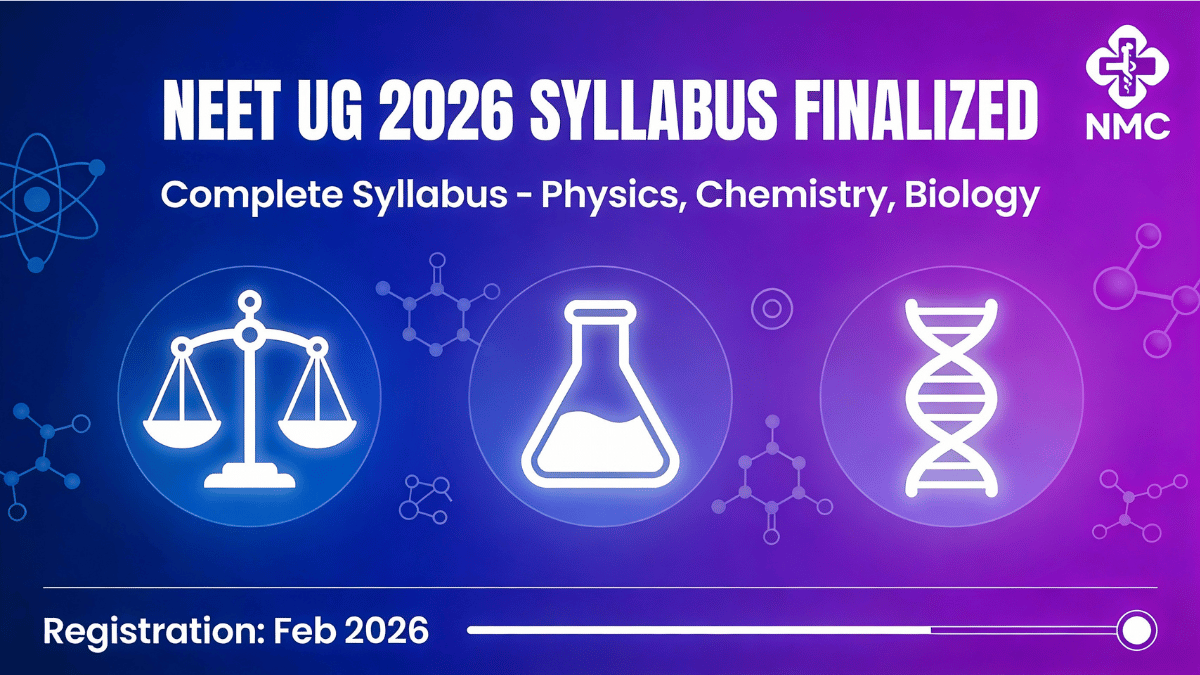
The National Medical Commission (NMC) has officially released the finalized syllabus for NEET UG 2026, marking a crucial milestone for medical aspirants preparing for the Undergraduate Medical Education Board (UGMEB) entrance examination. In an official public notice dated December 22, 2025, the NMC confirmed that the syllabus for the 2026-27 academic session is now available on the official website, nmc.org.in. This announcement brings clarity and stability to exam preparation, as no chapters have been removed from physics, chemistry, or biology.
Key Announcement: No Chapter Removals
What Changed and What Didn’t
The most significant aspect of the NEET UG 2026 syllabus finalization is that no major chapters or topics have been removed. A detailed comparison between the NEET UG 2025 and 2026 syllabi reveals that the overall structure remains unchanged. This consistency is crucial for students who have already begun their preparation, as it allows them to continue following their study plans without concern about sudden syllabus reductions.
The NMC’s decision to maintain the complete syllabus ensures that candidates have comprehensive knowledge of all topics, which is essential for medical education and professional practice. The retention of all chapters reflects the NMC’s commitment to maintaining rigorous academic standards for MBBS entrance examinations.
Availability of Updated Syllabus
The updated NEET UG 2026 syllabus is now publicly available on the NMC’s official website (nmc.org.in). This document serves as a reference for:
- Students preparing for the examination
- Educational institutions developing study materials
- Coaching centers designing curricula
- Parents and guardians tracking their wards’ preparation
Complete NEET UG 2026 Subject-Wise Syllabus
PHYSICS SYLLABUS (20 Units)
Physics forms one of the three core subjects in NEET and tests conceptual understanding, application of principles, and problem-solving abilities. The complete physics syllabus includes:
- Physics and Measurements – Understanding SI units, measurement errors, and precision
- Kinematics – Motion in one and two dimensions, displacement, velocity, and acceleration
- Laws of Motion – Newton’s laws, friction, and dynamics of circular motion
- Work, Energy and Power – Work-energy theorem, conservation of energy, and power calculations
- Rotational Motion – Angular velocity, moment of inertia, and torque
- Gravitation – Newton’s law of gravitation, orbital mechanics, and satellite motion
- Properties of Solids and Liquids – Elasticity, surface tension, and viscosity
- Thermodynamics – First and second laws, heat engines, and entropy
- Kinetic Theory of Gases – Gas laws, molecular motion, and kinetic energy
- Oscillations and Waves – Simple harmonic motion, wave properties, and sound waves
- Electrostatics – Electric field, potential, and capacitance
- Current Electricity – Ohm’s law, circuit analysis, and energy dissipation
- Magnetic Effects of Current and Magnetism – Lorentz force, magnetic field, and electromagnetic effects
- Electromagnetic Induction and Alternating Currents – Faraday’s law and AC circuits
- Electromagnetic Waves – Maxwell’s equations and properties of electromagnetic waves
- Optics – Reflection, refraction, lenses, and wave optics
- Dual Nature of Matter and Radiation – Photoelectric effect and de Broglie waves
- Atoms and Nuclei – Atomic structure, nuclear physics, and radioactivity
- Electronic Devices – Semiconductors, diodes, and transistors
- Experimental Skills – Laboratory techniques and practical understanding
CHEMISTRY SYLLABUS (20 Units)
Chemistry is divided into three main branches: Physical Chemistry, Inorganic Chemistry, and Organic Chemistry. Each branch contains essential topics for medical education:
Physical Chemistry (7 Units)
- Some Basic Concepts of Chemistry – Mole concept, atomic mass, and stoichiometry
- Atomic Structure – Bohr’s model, quantum mechanics, and electron configuration
- Chemical Bonding and Molecular Structure – Ionic and covalent bonding, hybridization
- Chemical Thermodynamics – Enthalpy, entropy, and Gibbs free energy
- Solutions – Types of solutions, concentration terms, and colligative properties
- Equilibrium – Chemical and ionic equilibrium, Le Chatelier’s principle
- Redox Reactions and Electrochemistry – Oxidation states, electrochemical cells, and galvanic cells
Inorganic Chemistry (4 Units)
- Chemical Kinetics – Reaction rates, order of reaction, and rate equations
- Classification of Elements and Periodicity in Properties – Periodic table trends and periodic properties
- P-Block Elements – Groups 13-18 elements and their chemistry
- d- and f-Block Elements – Transition metals and lanthanides/actinides
Organic Chemistry (9 Units)
- Coordination Compounds – Ligands, crystal field theory, and complex formation
- Purification and Characterisation of Organic Compounds – Separation techniques and identification tests
- Some Basic Principles of Organic Chemistry – IUPAC nomenclature and reaction mechanisms
- Hydrocarbons – Alkanes, alkenes, alkynes, and aromatic compounds
- Organic Compounds Containing Halogens – Halogenation and halogenated compounds
- Organic Compounds Containing Oxygen – Alcohols, aldehydes, ketones, and carboxylic acids
- Organic Compounds Containing Nitrogen – Amines, amides, and nitriles
- Biomolecules – Carbohydrates, proteins, lipids, and nucleic acids
- Principles Related to Practical Chemistry – Laboratory techniques and safety
BIOLOGY SYLLABUS (10 Units)
Biology carries 50% weightage in NEET and focuses on both theoretical knowledge and practical understanding of living organisms:
- Diversity in the Living World – Classification of organisms, taxonomy, and biodiversity
- Structural Organisation in Animals and Plants – Cell types, tissue organization, and organ systems
- Cell Structure and Function – Cell organelles, membrane structure, and cellular functions
- Plant Physiology – Photosynthesis, respiration, and plant growth
- Human Physiology – Major organ systems, homeostasis, and physiological processes
- Reproduction – Sexual and asexual reproduction in plants and animals
- Genetics and Evolution – Mendelian genetics, molecular genetics, and evolution theories
- Biology and Human Welfare – Public health, disease management, and human development
- Biotechnology and Its Applications – Genetic engineering, fermentation, and modern biotechnology
- Ecology and Environment – Ecosystems, environmental issues, and conservation
NEET Question Paper Structure and NCERT Alignment
NCERT-Based Questions
The National Testing Agency (NTA) emphasizes that the NEET UG question paper will be mostly based on the Physics, Chemistry, and Biology subjects followed in the NCERT syllabus. This means candidates who thoroughly study NCERT textbooks will have a strong foundation for the examination.
No Specific Textbook Recommendations
It is important to note that the NTA does not recommend any specific textbooks for NEET preparation. This approach provides candidates with the flexibility to:
- Choose study materials that align with their learning style
- Consult multiple resources for comprehensive understanding
- Access both traditional and digital learning resources
- Work with coaching centers or self-study as per their preference
However, NCERT textbooks remain the primary reference point, as the examination is structured around NCERT curriculum standards.
Important Timelines and Registration Schedule
NEET UG 2026 Registration
According to past trends and institutional practices:
- Expected Registration Start Date: First week of February 2026
- Registration Portal: neet.nta.nic.in (official NTA website)
- Announcement Channel: All updates will be posted on the official NTA website
NEET UG 2026 Examination Date
The National Testing Agency (NTA) is expected to announce the NEET UG 2026 examination date very soon on the official website (neet.nta.nic.in). Candidates are advised to:
- Monitor the official NTA website regularly
- Enable notifications for updates
- Follow official social media channels of NTA
- Avoid relying on rumors or unofficial sources
Academic Session Coverage
The finalized syllabus will be applicable for:
- Academic Session: 2026-27
- Programs Covered: MBBS admissions across India
- Implementation: All medical colleges and universities in India
Preparation Strategy and Recommendations
Study Approach
With the complete syllabus confirmed, candidates should adopt the following preparation strategy:
- Foundation Building: Start with NCERT textbooks to build conceptual clarity in all three subjects
- Topic-Wise Mastery: Complete each unit thoroughly before moving to the next
- Regular Practice: Solve previous year question papers and mock tests
- Performance Analysis: Identify weak areas and focus additional effort on them
- Revision: Allocate sufficient time for revision of all topics before the examination
Subject-Wise Focus
Physics: Emphasize conceptual understanding alongside mathematical problem-solving. Pay special attention to numerical problems and derivations.
Chemistry: Master the periodic table trends, reaction mechanisms, and chemical equations. Organic chemistry requires regular practice and memorization of functional groups.
Biology: Focus on diagrams, anatomical structures, and physiological processes. Regular revision of classifications and lifecycle diagrams is essential.
Free Resources and Mock Tests
Candidates can access:
- Free NEET 2026 Mock Test PDFs with detailed solutions
- Practice question banks with real exam-style questions
- Performance analysis tools on official portals
- Subject-wise revision materials
Frequently Asked Questions
Q1: Has any chapter been removed from NEET 2026?
Answer: No. The NMC has confirmed that no chapters have been removed from physics, chemistry, or biology. The syllabus structure remains unchanged from previous years.
Q2: Should I follow NCERT textbooks exclusively?
Answer: NCERT textbooks form the primary basis for NEET questions, so they should be your foundation. However, supplementary materials can help in deeper understanding of specific topics.
Q3: When will NEET 2026 registration open?
Answer: Based on past trends, registration is expected to begin in the first week of February 2026. However, the exact dates will be announced by the NTA on neet.nta.nic.in.
Q4: Where can I download the complete syllabus document?
Answer: The official NEET UG 2026 syllabus is available on the NMC official website (nmc.org.in).
Q5: What is the weightage of each subject in NEET?
Answer: NEET follows the distribution: Physics (25%), Chemistry (25%), and Biology (50%).
Implications for Educational Institutions and Coaching Centers
For Schools and Colleges
Educational institutions should ensure that their physics, chemistry, and biology curricula align fully with the NCERT syllabus and NEET standards. The confirmation of the unchanged syllabus allows institutions to continue their existing curriculum plans without modifications.
For Coaching Centers
Coaching institutions can use this finalized syllabus to:
- Design structured batch programs without curriculum changes
- Develop comprehensive study materials covering all topics
- Create focused revision schedules before the examination
- Offer specialized doubt-clearing sessions for complex topics
Main Point
The National Medical Commission’s finalization of the NEET UG 2026 syllabus without any chapter removals represents a commitment to maintaining rigorous medical education standards. With the complete syllabus confirmed and NCERT as the primary reference, candidates now have a clear roadmap for their preparation.
Success in NEET 2026 requires:
- Comprehensive Coverage: Study all units thoroughly without skipping any topics
- Conceptual Clarity: Focus on understanding rather than rote memorization
- Consistent Practice: Regular problem-solving and mock test attempts
- Strategic Revision: Plan revision sessions strategically across all three subjects
- Time Management: Balance preparation across physics, chemistry, and biology effectively
Candidates should begin their preparation immediately, utilize the available free resources and mock tests, and stay updated with official announcements on neet.nta.nic.in. With proper planning, consistent effort, and comprehensive study of the finalized syllabus, aspirants can work towards securing their place in India’s prestigious MBBS programs.
For the latest updates, candidate guidelines, and registration information, always refer to the official NTA website and the NMC portal.
View the Notice Click On The Link : –
https://medicaldialogues.in/pdf_upload/nmc-updated-syllabus-for-neetug-2026-316515.pdf