India and Uzbekistan are two nations separated by geography but connected by centuries of history, trade routes, and cultural exchange. While both countries share ancient roots through the legendary Silk Road, they have developed distinct cultural identities shaped by their unique histories, geographies, and peoples.
Understanding the cultural differences between India and Uzbekistan is increasingly important for students considering MBBS education abroad, business professionals, and cultural enthusiasts exploring international connections. This comprehensive guide examines the key cultural distinctions while highlighting the surprising similarities that continue to strengthen ties between these two nations.
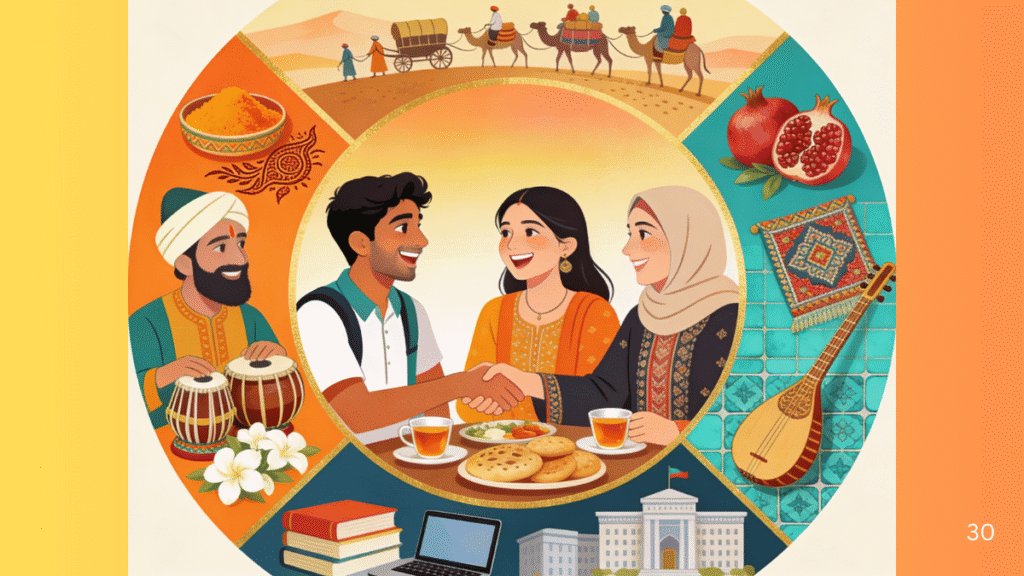
1: Family Values and Social Structure
India’s Family Culture
In India, the family is considered the cornerstone of society. Multi-generational households remain common, with joint families living under one roof. Respect for elders is deeply embedded in Indian culture through traditions like touching elders’ feet as a sign of respect.
Key characteristics include:
- Hierarchy: Clear age-based hierarchy within families
- Interdependence: Strong financial and emotional interdependence
- Decision-Making: Parents often make major life decisions for children
- Collectivism: Individual choices are frequently made considering family welfare
Uzbekistan’s Family Traditions
Uzbek culture also prioritizes family, but with a different structure. While families tend to be nuclear after marriage, the concept of “Mahalla” (neighborhood community) creates an extended support system where neighbors function like family members.
Key characteristics include:
- Respect for Elders: Similar to India, but expressed through different rituals
- Community Bonds: Mahalla system creates strong neighborhood ties
- Parental Authority: Parents have significant influence over children’s choices
- Hospitality: Extraordinary emphasis on welcoming guests as family members
Comparison: Family Structure
| Aspect | India | Uzbekistan |
|---|---|---|
| Household Type | Multi-generational (joint families common) | Nuclear, with strong community ties |
| Respect Expression | Touching feet, verbal deference | Serving tea, standing for elders |
| Extended Family | Live together | Mahalla system, neighborhood support |
| Age Hierarchy | Strictly observed | Important but more flexible |
| Guest Treatment | Respectful, but boundaries maintained | Exceptionally warm, guest-first mentality |
2: Religion and Spirituality
Religious Landscape in India
India is a secular, multi-religious nation where Hinduism, Islam, Christianity, Sikhism, Buddhism, and Jainism coexist. This religious diversity is protected by the Constitution and celebrated through numerous festivals.
Religious Characteristics:
- Polytheism in Hinduism: Worship of multiple deities representing different aspects of divinity
- Festivals: Diwali, Holi, Eid, Christmas, and Gurunanak Jayanti are celebrated with equal enthusiasm
- Religious Tolerance: Constitutional commitment to secularism
- Spiritual Practices: Yoga, meditation, and ayurveda are integral to daily life
- Sacred Sites: Temples, mosques, gurdwaras, and churches coexist in most cities
Religious Culture in Uzbekistan
Uzbekistan is predominantly Muslim (Sunni Islam, ~88-90%), but maintains a secular government where religion remains largely personal and separate from state affairs.
Religious Characteristics:
- Sunni Islam: Primary faith with Central Asian Sufi traditions
- Government Secularism: Religion is not integrated into state policies
- Tolerance: Minority religions (Christianity, Judaism) are peacefully accommodated
- Spiritual Evolution: Younger generations view faith as personal choice
- Modern Spirituality: Growing interest in yoga and mindfulness among youth
Key Differences
In India: Religion is publicly visible, celebrated, and integrated into daily life with festivals, dietary practices, and social ceremonies.
In Uzbekistan: Religion is more private; public spaces maintain secular character while respecting individual beliefs.
3: Food and Cuisine
Indian Food Culture
Indian cuisine is world-renowned for its diversity, aromatic spices, and regional variations. Food is not just sustenance but a cultural expression and social connector.
Culinary Characteristics:
- Spice-Heavy: Abundant use of turmeric, cardamom, cinnamon, coriander, and chili
- Regional Diversity: Each region has distinct dishes (North Indian, South Indian, Bengali, Gujarati cuisines)
- Vegetarianism: Large vegetarian population due to religious beliefs
- Ritual Significance: Food plays role in religious ceremonies and festivals
- Meal Structure: Often includes rice/bread, curry, vegetables, and condiments
Popular Dishes:
- Biryani, Paneer Tikka, Samosa, Dosa, Tandoori Chicken, Curry varieties
Uzbek Food Culture
Uzbek cuisine reflects Central Asian traditions and is heartier, rice-based, and meat-centric. Food is central to hospitality and social gatherings.
Culinary Characteristics:
- Rice-Based: Pilaf (Plov) is the national dish, prepared with meat and carrots
- Meat-Heavy: Mutton, beef, and chicken are primary proteins
- Minimal Spice: Uses cumin, black pepper, and fresh herbs rather than numerous spices
- Bread Importance: Tandoori bread (non) is a staple at every meal
- Communal Eating: Food is meant to be shared from large platters
Popular Dishes:
- Plov (Pilaf), Shashlik (kebabs), Samsa (pastries), Lagman (noodles), Manti (dumplings)
Culinary Comparison
| Aspect | India | Uzbekistan |
|---|---|---|
| Base Ingredient | Rice, wheat, lentils | Rice, wheat |
| Flavor Profile | Multi-layered, aromatic spices | Cumin, herbs, subtle flavors |
| Vegetarianism | Common and celebrated | Minimal, meat-centric |
| Signature Dish | Biryani, Curry | Plov (Pilaf) |
| Eating Style | Individual plates, hand-eating common | Communal platters |
| Bread | Roti, naan, various types | Tandoori (non) |
| Meal Speed | Can be leisurely | Communal, time-flexible |
Interesting Note: Despite different flavor profiles, both cuisines emphasize hospitality. In India, serving guests food is considered sacred duty. In Uzbekistan, refusal of offered food is considered insulting.
4: Music, Arts, and Entertainment
Indian Arts and Entertainment
Indian cultural expression is vibrant, diverse, and globally recognized through film and music industries.
Entertainment Landscape:
- Bollywood: World’s largest film industry by output, hugely influential in Central Asia
- Classical Arts: Kathak, Bharatanatyam, and other classical dance forms with spiritual roots
- Music Genres: Classical (Hindustani/Carnatic), Ghazals, Devotional, Pop, and Hip-Hop
- Festival Integration: Arts are central to festivals like Holi and Diwali
- Actors as Icons: Film stars like Raj Kapoor, Amitabh Bachchan, and Shah Rukh Khan are cultural ambassadors
Uzbek Arts and Entertainment
Uzbekistan blends traditional Central Asian arts with modern influences, creating a unique cultural identity.
Entertainment Landscape:
- Traditional Music: Shashmaqam (classical music), folk instruments (Dutar, Doira)
- Epic Storytelling: Preservation of ancient narratives and poetry traditions
- Modern Music: Pop, rap, and electronic music gaining prominence among youth
- Dance: Both traditional folk dances and contemporary styles
- Architecture as Art: Historic monuments and modern art spaces celebrate culture
- Festival Revival: Navruz (Persian New Year) and other festivals showcase artistic traditions
Interesting Cultural Note
Bollywood’s Impact in Uzbekistan: Indian films have been extremely popular in Uzbekistan for decades. Older generations reminisce about actors like Raj Kapoor and Amitabh Bachchan, while younger people are drawn to contemporary stars like Shah Rukh Khan. There’s even a popular restaurant in Tashkent named “Raj Kapoor,” symbolizing this deep cultural connection.
Arts Comparison
| Aspect | India | Uzbekistan |
|---|---|---|
| Primary Industry | Bollywood (film and music) | Traditional arts and modern fusion |
| Classical Forms | Kathak, Bharatanatyam, Odissi | Shashmaqam, Maqom |
| Musical Instruments | Sitar, Tabla, Sarod | Dutar, Doira, Ney |
| Modern Trends | Pop, Hip-Hop, Indie music | Urban pop, Electronic, Rap |
| Global Reach | Extensive (Bollywood worldwide) | Growing (diaspora and tourism) |
| Youth Culture | Music and film centric | Balanced traditional and modern |
5: Education and Language
Indian Education System
Education in India reflects its diversity and aims to balance traditional knowledge with modern learning.
Educational Characteristics:
- Languages: English is the medium of instruction in most schools; regional languages co-exist
- System: Influenced by British colonial education (10+2+3 structure)
- Diversity: Technical education (IITs), medicine (AIIMS), and humanities equally valued
- Oral Traditions: Recitation of religious texts and poetry remains culturally important
- Modern Integration: STEM education gaining prominence with entrepreneurship focus
Professional Opportunities:
- Medicine (MBBS), Engineering, Management, Law, and Arts equally pursued
Uzbek Education System
Uzbekistan prioritizes education as a national development tool and emphasizes both traditional knowledge and international standards.
Educational Characteristics:
- Languages: Uzbek primary language; Russian and English increasingly used
- Modern Integration: Universities offering international programs in English
- Technical Focus: IT, Engineering, and Medicine highly valued
- Heritage Learning: Traditional poetry and culture taught as part of curriculum
- Technology Adoption: Online education platforms becoming mainstream
- International Exposure: Growing student exchange programs
Professional Opportunities:
- Medicine, Engineering, IT, and International Business programs
Educational Comparison
| Aspect | India | Uzbekistan |
|---|---|---|
| Medium | English (largely), regional languages | Uzbek, Russian, increasing English |
| System Structure | 10+2+3 (influenced by colonial system) | 11-year schooling + university |
| Higher Education | Decentralized, multiple universities | Mix of traditional and international |
| Technical Education | IITs, NITs highly prestigious | Growing tech institutes |
| Medical Education | Centralized NEET system, highly competitive | More accessible, international standards |
| Youth Abroad | Large student diaspora, diverse destinations | Growing study abroad trend |
6: Festivals and Celebrations
Major Indian Festivals
Indian festivals celebrate diverse religions, seasons, and historical events with color, food, and community gatherings.
Key Festivals:
- Diwali (October-November): Festival of lights, celebrated by Hindus, Sikhs, Jains, and Buddhists. Marks triumph of light over darkness with fireworks and sweets.
- Holi (March): Festival of colors celebrating spring and new beginnings. People throw colored powder and water on each other.
- Eid (Variable dates): Muslim festival celebrating end of Ramadan with family gatherings and special dishes.
- Christmas (December 25): Celebrated by Christian community and increasingly as secular holiday with decorations and gifts.
- Gurunanak Jayanti (November): Sikh festival honoring the founder of Sikhism with langar (free communal meals).
Major Uzbek Festivals
Uzbek festivals blend Islamic traditions with secular celebrations and cultural heritage preservation.
Key Festivals:
- Navruz (March 20-21): Persian New Year celebrated with 40 days of festivities. Most important celebration with parades, traditional foods, and folk music.
- Eid al-Fitr & Eid al-Adha (Variable dates): Islamic festivals celebrated with family, feasts, and community prayers.
- Independence Day (September 1): National holiday celebrating Uzbek independence with parades and cultural performances.
- Silk Road Festival (Recent addition): Celebrates Uzbekistan’s historic role in trade with music, arts, and cultural performances.
7: Social Etiquette and Hospitality
Indian Etiquette
Indian etiquette reflects respect for hierarchy, spirituality, and interpersonal warmth.
Key Customs:
- Greeting: Namaste (hands joined) is traditional; hugging close friends acceptable
- Footwear: Remove shoes in temples and some homes; accepted in most public spaces
- Dining Etiquette: Right hand used for eating (left hand considered unclean); sharing from same plate common
- Guest Treatment: “Atithi Devo Bhava” (Guest is God) philosophy guides hospitality
- Physical Contact: Gender-based norms; opposite-sex contact less common among strangers
- Directness: Indirect communication preferred; direct refusal considered rude
Uzbek Etiquette
Uzbek etiquette emphasizes extreme hospitality, respect for elders, and Islamic cultural norms.
Key Customs:
- Greeting: Handshake common; formal “Assalamu Alaikum” (Peace be upon you) among Muslims
- Footwear: Remove shoes when entering homes; gesture-based indication respected
- Dining Etiquette: Right hand primary; left hand avoided; shared meals highly honored
- Guest Treatment: Extraordinary emphasis on guest comfort; refusal of food considered insulting
- Physical Contact: Same-gender contact warm; opposite-sex more formal
- Directness: Respectful but direct communication valued; honesty appreciated
- Tea Ceremony: Serving and accepting tea (chai) is important social ritual
Hospitality Comparison
Both cultures excel in hospitality but express it differently:
India: Guest is treated as divine; personal attention and flexibility shown.
Uzbekistan: Guest is prioritized above all; comfort and abundance of food are paramount; refusal seen as rejection.
Note for Students: Indian and Uzbek hosts will both go out of their way to ensure your comfort. Understanding these nuances helps in appreciating their efforts genuinely.
8: Gender Roles and Social Dynamics
Gender Roles in India
India is experiencing transition in gender roles, with traditional and modern perspectives coexisting.
Current Dynamics:
- Traditional: Women’s primary role as homemakers; emphasis on family responsibility
- Modern: Increasing female participation in workforce, education, and politics
- Marriage: Arranged marriages still common, but love marriages increasingly accepted
- Diversity: Varies significantly by region, religion, and socioeconomic status
- Legal Framework: Constitution provides gender equality; practical implementation varies
Gender Roles in Uzbekistan
Uzbek society shows more gender parity in education and public life, though traditional roles persist in some areas.
Current Dynamics:
- Education: Girls’ education highly valued; literacy rates nearly equal to boys
- Workforce: Women actively participate in government, business, and education
- Marriage: Transition toward individual choice; family consultation important
- Modernity: Urban centers show progressive attitudes; rural areas more traditional
- Public Life: Women visible in professional and political spheres
Women in Society Comparison
| Aspect | India | Uzbekistan |
|---|---|---|
| Education Access | Improving but gaps exist | Nearly equal to males |
| Workforce Participation | Growing but conservative sectors | Well-established |
| Marriage Choice | Increasingly individual, but family involvement | Mix of traditional and individual choice |
| Political Representation | Reserved seats, growing participation | Active participation |
| Urban vs Rural | Significant difference | Less pronounced difference |
9: Historical and Spiritual Connections
The Silk Road Legacy
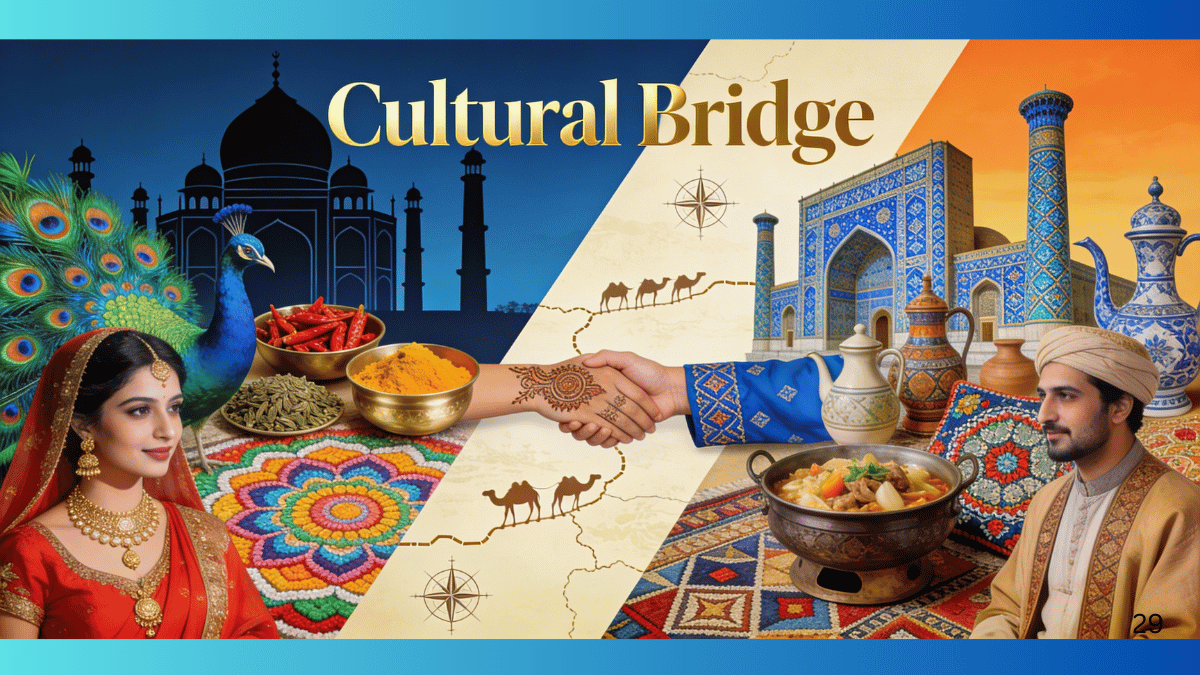
The Silk Road is the tangible historical connection between India and Uzbekistan. This ancient trade network did more than exchange goods—it facilitated cultural, intellectual, and spiritual exchange.
Key Connections:
- Buddhist Heritage: Buddhism traveled from India to Central Asia through Silk Road routes
- Architectural Influence: Indian architectural styles influenced Central Asian designs
- Intellectual Exchange: Indian mathematics, astronomy, and philosophy influenced Central Asian scholars
- Spice Trade: Indian spices and products were highly valued in Silk Road markets
Mughal Connection
Babur, founder of the Mughal Empire, was born in Fergana Valley (present-day Uzbekistan) but established one of history’s greatest empires in India. His autobiography, Baburnama, documents life in both regions.
Impact:
- Persian-influenced architecture in India reflects Central Asian heritage
- Mughal art, music, and cuisine blend Central Asian and Indian traditions
- This dynasty created lasting cultural synthesis
Sufi Spirituality
Sufism, Islamic mysticism, created a spiritual bridge between the regions. Sufi shrines in both countries attract devotees from across the world, promoting spiritual exchange and mutual respect.
10: Modern Cultural Exchange
Bollywood’s Influence
One of the most powerful cultural connectors between India and Uzbekistan is Indian cinema. For decades, Bollywood movies have captivated Uzbek audiences.
Evidence of Connection:
- Multiple generations in Uzbekistan have grown up watching Indian films
- Older Uzbeks cite Raj Kapoor and Amitabh Bachchan as cultural icons
- Younger generations follow contemporary Bollywood stars
- “Raj Kapoor” restaurant in Tashkent is testament to this soft power
- Indian music, fashion, and lifestyle trends influence Uzbek youth
Educational Exchange
An increasing number of Uzbek students are pursuing higher education in India, particularly in medical and technological fields. This creates direct cultural exchange at personal level.
Tourism and People-to-People Contact
Recent travel accounts reveal deep affection Uzbek people have for Indian visitors. Many Uzbeks:
- Express genuine warmth upon learning someone is Indian
- Reference Bollywood movies and actors in casual conversations
- Share curiosity about Indian religions, food, and lifestyle
- Treat Indian visitors with exceptional hospitality
This suggests cultural connection transcends formal diplomacy and reaches grassroots level.
11: Challenges and Misconceptions
Understanding Diversity
Common Misconception: Treating India or Uzbekistan as monolithic.
Reality: Both countries have significant internal diversity:
- India: Regional differences are profound; a Tamil Nadu resident’s culture differs significantly from Punjabi
- Uzbekistan: Urban vs. rural lifestyles differ; regional variations exist despite smaller size
Stereotyping
For Students Pursuing MBBS Abroad:
Understanding cultural nuances prevents culture shock and helps in:
- Appreciating local customs without judgment
- Navigating social situations with respect
- Building genuine friendships with local students and staff
- Adapting to educational and lifestyle differences
Language and Communication
Hindi/Urdu vs. Uzbek: While some might assume language similarities, Uzbek belongs to Turkic language family, completely distinct from Indian languages.
12: Lessons for Students and Professionals
For MBBS Students Considering Uzbekistan
Understanding these cultural differences prepares you for:
- Family Expectations: Both cultures value family highly; regular communication with family is expected
- Food Adaptation: While Indian food is available, learning to enjoy local Uzbek cuisine enriches experience
- Hospitality Reciprocity: When Uzbeks show hospitality, accepting with warmth is culturally important
- Religious Respect: Respecting Islamic practices (prayer times, Ramadan) is essential
- Academic Discipline: Medical education demands similar respect for hierarchy in both countries
For Cultural Professionals and Diplomats
- Localization Over Translation: Content should be adapted culturally, not just translated
- Respect for Traditions: Both nations value their heritage; modern development shouldn’t disregard traditions
- Soft Power: Cultural exchanges through education, arts, and people-to-people contact are powerful diplomatic tools
- Mutual Learning: Approach with curiosity; both cultures have valuable insights
Main Point
India and Uzbekistan represent two fascinating civilizations with distinct cultural identities yet surprising commonalities. While separated by geography, they share:
- Historical Connections: Silk Road, Mughal era, Sufi traditions
- Core Values: Family importance, guest hospitality, respect for traditions
- Modern Exchange: Educational partnerships, Bollywood influence, increasing people-to-people contact
The differences—in food, religion, language, and daily customs—are not barriers but opportunities for mutual enrichment. For students pursuing MBBS in Uzbekistan, understanding these cultural nuances transforms the experience from mere academic pursuit to a meaningful cultural immersion.
As both nations continue developing, their historical friendship provides foundation for educational, economic, and cultural partnerships that benefit both peoples.
Frequently Asked Questions : Cultural Differences Between India and Uzbekistan
Q1: Can I find Indian food in Uzbekistan?
A: Yes, Indian restaurants exist in major cities like Tashkent, though availability varies. However, adapting to local Uzbek cuisine enriches your experience and aids cultural integration.
Q2: Is English spoken in Uzbekistan?
A: English is increasingly common, especially among younger people and in universities. However, learning basic Uzbek phrases is helpful and appreciated by locals.
Q3: How important is religion in daily life in Uzbekistan?
A: Religion is personal in Uzbekistan despite majority Muslim population. Public life remains secular. Respecting prayer times and Ramadan practices is courteous but not enforced.
Q4: Why do Uzbeks love Indian movies?
A: Decades of Bollywood films entering Central Asia created cultural connection. Indian storytelling, music, and values resonated with Uzbek audiences across generations.
Q5: What should I know about family expectations?
A: Both cultures value family. Regular communication with family is expected. Respect for elders and involvement in family matters is important in both societies.
Q6: Can women travel alone in Uzbekistan?
A: Yes. Uzbekistan is generally safe for solo female travelers. Understanding local customs around dress and behavior helps avoid unwanted attention, similar to India.
Q7: How different is Uzbek cuisine from Indian food?
A: Very different in flavor profile. Uzbek food is rice and meat-based with subtle spices, while Indian cuisine is spice-heavy and includes diverse vegetarian options. Both are delicious but require palate adjustment.
Q8: What are the main Islamic practices I should know?
A: Five daily prayers, modest dress expectations (particularly for women), and Ramadan fasting are observed. However, enforcement varies; universities are relatively liberal.