Major Reform in Kyrgyzstan’s Medical Education System
In a significant move to improve the quality of medical education, the Ministry of Health of the Kyrgyz Republic has announced the results of a nationwide state accreditation process for medical universities. The evaluation was conducted under the Presidential Decree “On the Introduction of a State Monopoly on the Training of Specialists in Healthcare” issued on August 28, 2025.
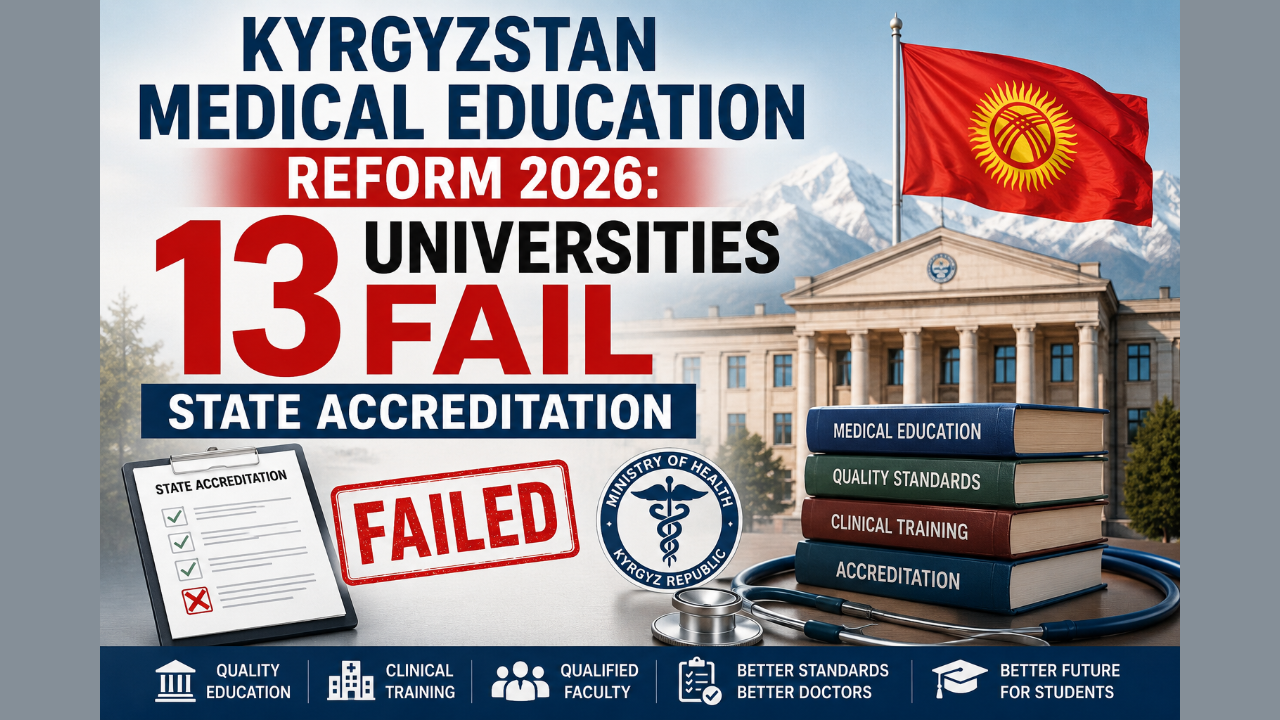
The results have raised serious concerns across the medical education sector. Out of the universities that applied for accreditation, 13 medical institutions failed to meet the required quality standards, while only four universities received the highest accreditation status.
For international students, especially those planning to pursue MBBS in Kyrgyzstan, these developments highlight the importance of choosing a recognized and accredited medical university.
Why Was This Accreditation Conducted?
The accreditation process is part of a broader reform aimed at improving healthcare education and ensuring that future doctors receive quality training.
The reform is based on:
- The Law on Amendments to Certain Legislative Acts in the Spheres of Education, Science, and Healthcare (January 23, 2026)
- Resolution No. 254 of the Cabinet of Ministers (April 16, 2026), which introduced new accreditation standards
The Ministry of Health stated that the goal is not merely to check compliance with regulations but to ensure that medical graduates possess the knowledge, skills, and clinical experience required for modern healthcare practice.
Medical Education Landscape in Kyrgyzstan
Currently, Kyrgyzstan has:
- 34 higher education institutions offering medical programs
- 12 state universities
- 22 private (non-state) universities
Three universities were exempt from the accreditation process due to their special legal status:
- Kyrgyz State Medical Academy (KSMA)
- Kyrgyz-Russian Slavic University (KRSU)
- Kyrgyz-Turkish University “Manas”
A total of 24 universities submitted applications for state accreditation.
Universities That Received Full Accreditation (6 Years)
Only four institutions successfully met all major quality requirements and received the maximum six-year accreditation:
- Osh State University (OshSU)
- International University of Kyrgyzstan (MUK)
- International Higher School of Medicine (IHSM)
- Asian International University named after S. Tentishev
Receiving a six-year accreditation indicates strong performance in areas such as faculty qualifications, clinical training facilities, infrastructure, and academic quality.
Universities Granted Temporary Accreditation (1 Year)
Seven institutions received conditional accreditation for one year. These universities must address identified shortcomings before applying for a longer accreditation period.
The universities are:
- Kyrgyz National University named after J. Balasagyn
- Jalal-Abad State University
- Kyrgyz-Uzbek International University
- Issyk-Kul State University
- Jalal-Abad International University
- University of South Asia
- International European University
Students considering these universities should closely monitor future accreditation updates.
13 Medical Universities That Failed State Accreditation
The following institutions did not meet the required standards and failed the accreditation process:
- International Medical University “Avicenna”
- ADAM University
- Roel Metropolitan University
- Altamimi International University
- Ala-Too International University
- International Medical University
- Kyrgyz Medical and Dental Institute
- Salymbekov University
- Eurasian International University
- Bishkek International Medical Institute
- International University of Medicine and Science
- Central Asian International Medical University
- Osh International Medical University
The failure to obtain accreditation raises important questions regarding academic quality, clinical exposure, infrastructure, and faculty resources at these institutions.
Universities That Did Not Participate in Accreditation
Seven universities with medical programs did not participate in the accreditation process within the specified timeframe:
- Kyrgyz State University named after I. Arabaev
- Batken State University
- Naryn State University
- Kyrgyz National Agrarian University
- International University of Science and Business
- Kyrgyz International University of NRZ
- Medical Institute “Zamanbap”
Students should exercise caution when considering institutions that have not completed the state accreditation process.
How Were Universities Evaluated?
The accreditation commissions assessed universities based on several critical criteria:
Faculty Strength
Availability of qualified professors, doctors, and teaching staff.
Clinical Training Facilities
Access to hospitals and clinical centers where students gain practical experience.
Infrastructure
Classrooms, laboratories, simulation centers, libraries, and technological resources.
Academic Programs
Quality of curriculum, teaching methods, and assessment systems.
Educational Management
Overall organization and effectiveness of the educational process.
Universities were required to demonstrate compliance across all these areas to receive accreditation.
What Does This Mean for Indian MBBS Aspirants?
For Indian students planning to study MBBS abroad, this development serves as an important reminder that university selection should be based on verified academic quality rather than marketing claims.
Before choosing a medical university in Kyrgyzstan, students should:
- Verify the latest accreditation status.
- Check clinical training facilities.
- Review faculty qualifications.
- Confirm recognition by relevant authorities.
- Research graduate outcomes and licensing examination performance.
- Consult official government and university sources.
A recognized and accredited university can play a significant role in ensuring quality education and future career opportunities.
Key Takeaway
The 2026 accreditation results mark a major turning point in Kyrgyzstan’s medical education sector. With 13 universities failing accreditation and only four securing the highest six-year approval, the government has sent a strong message about the importance of educational quality.
For students and parents exploring MBBS opportunities in Kyrgyzstan, accreditation status should now be one of the most important factors in the decision-making process. Choosing a university that meets national quality standards can help ensure a stronger academic foundation, better clinical exposure, and improved career prospects after graduation.