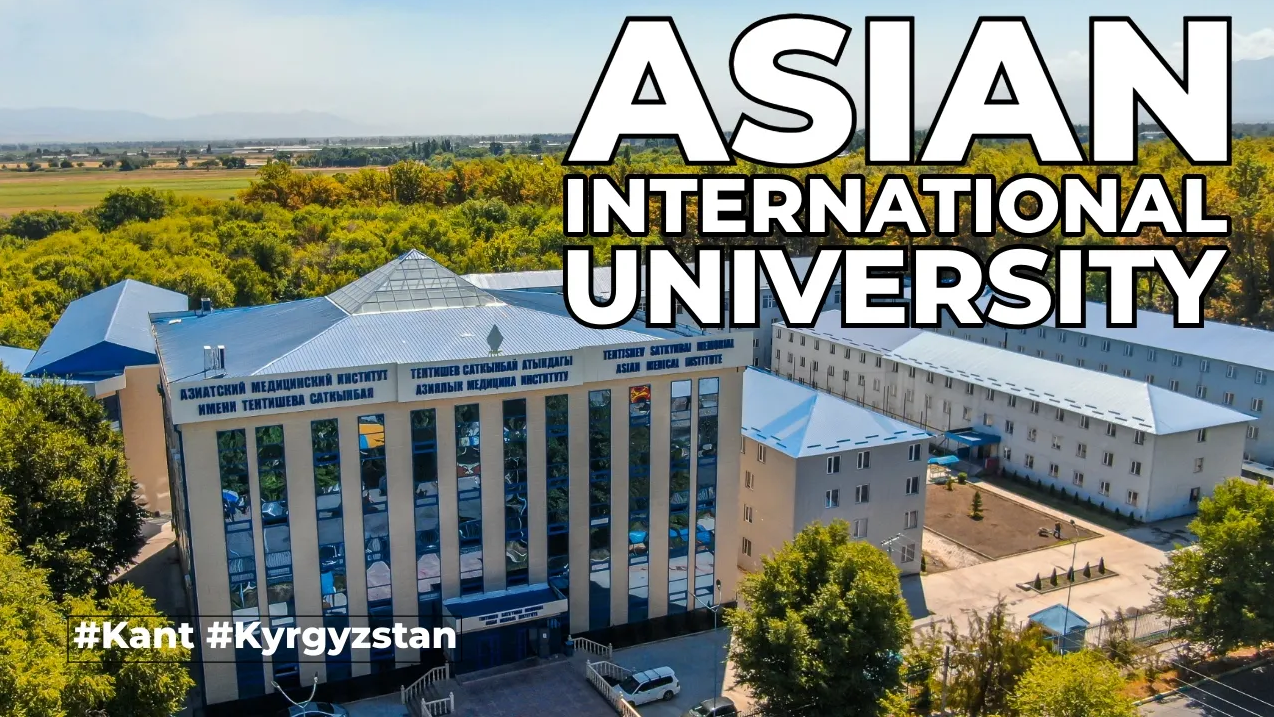
Asian Medical Institute, officially known today as S. Tentishev Asian International University, is a private medical university in Kant, Kyrgyzstan. The institution was established in 2004 and is located at 58 Gagarin Street, Kant, around 20 km from Bishkek, the capital of Kyrgyzstan. The university was formerly known as the S. Tentishev Asian Medical Institute and continues to be widely known as Asian Medical Institute or ASMI.
For students looking for an affordable medical education abroad, particularly students from India and other Asian countries, the university offers General Medicine programs in English, along with Dentistry and postgraduate medical programs.
Quick Overview Asian Medical Institute – S. Tentishev Asian International University, Kyrgyzstan
| Particular | Details |
|---|---|
| University Name | S. Tentishev Asian International University |
| Former Name | S. Tentishev Asian Medical Institute / Asian Medical Institute |
| Established | 2004 |
| Country | Kyrgyzstan |
| City | Kant |
| Location | Chui Region, Kyrgyz Republic |
| Type | Private Medical University |
| Medical Program | General Medicine / MBBS-MD |
| Duration | 5-year and 6-year programs |
| Medium | English for General Medicine |
| Dentistry | 5 years |
| International Students | Students from more than 14 countries according to the university |
| WDOMS | Listed as Asian International University named after Satkynbai Tentishev |
| 2026 State Accreditation | Institutional accreditation and General Medicine 5-year/6-year programs accredited for 6 years |
| Address | 58 Gagarin Street, Kant, Kyrgyzstan |
The university’s current website lists 20+ years of operation, students from more than 14 countries, and multiple academic programs.
History of Asian Medical Institute
Asian Medical Institute was established in 2004 and developed as an institution focused on medical education for students from Kyrgyzstan and other countries.
Over the years, it became particularly popular among international students. The university’s present official name is Asian International University named after Satkynbai Tentishev.
The World Directory of Medical Schools (WDOMS) lists the institution as Asian International University named after Satkynbai Tentishev, with Asian Medical Institute named after Satkynbay Tentishev and S. Tentishev Asian Medical Institute listed as alternate names. WDOMS records the school as a private, currently operational medical school, with instruction beginning in 2004.
Location of Asian Medical Institute
The university is located in Kant, in the Chui Region of Kyrgyzstan.
Kant is approximately 20 kilometres from Bishkek, making it possible for students to access the facilities and services of the capital while living in a comparatively smaller city.
The official university address is:
Asian International University named after S. Tentishev
58 Gagarin Street
Kant, Kyrgyz Republic
The university also operates academic facilities at 3 Sovetskaya Street, Kant.
Why is Kant a good location for students?
- Close to Bishkek
- Convenient road connectivity
- Lower-cost student environment compared with many major international cities
- Multicultural student population
- Access to hospitals and clinical training facilities
- Suitable environment for focused medical studies
MBBS/MD at Asian Medical Institute
The university’s General Medicine program is offered in 5-year and 6-year formats, with English listed as the medium of instruction.
Students study basic medical sciences during the early stages and gradually move toward clinical subjects and practical training.
Major areas of medical education include:
- Anatomy
- Histology
- Cytology
- Embryology
- Physiology
- Biochemistry
- Microbiology
- Pathology
- Pharmacology
- Medical Informatics
- Internal Medicine
- Surgery
- Pediatrics
- Obstetrics and Gynecology
- Emergency and Disaster Medicine
- Other clinical disciplines
The university’s postgraduate information also describes theoretical departments such as Anatomy and Topographic Anatomy, Histology, Microbiology and Virology, Normal Physiology, Pathological Physiology, Chemistry and Biochemistry, along with clinical departments in medicine, dentistry and surgery.
5-Year and 6-Year General Medicine Programs
One important point for prospective students is that the university currently lists both:
General Medicine – 5 Years
English Medium
General Medicine – 6 Years
English Medium
The university’s website identifies both options, while the World Directory of Medical Schools confirms that the institution offers a Medicine program.
Students should carefully confirm which course duration applies to their admission category and graduation pathway before paying fees.
For Indian students, the program should also be evaluated against the latest National Medical Commission (NMC) Foreign Medical Graduate regulations rather than relying only on a university’s marketing statement.
NMC and Indian Student Requirements
Indian students planning to study medicine abroad must meet the applicable NMC requirements.
In particular, students should check the current requirements relating to:
- NEET qualification
- Academic eligibility
- Course duration
- Medium of instruction
- Clinical training
- Internship
- Licensing requirements
- Screening/licensing examination requirements applicable at the time of graduation
The NMC’s official FAQ on the Foreign Medical Graduates regulations states that the compulsory internship component has a minimum duration of 12 months in the same foreign medical institution, subject to the applicable regulations. (NMC)
Important: Recognition of a university or its listing in an international directory does not by itself guarantee that an Indian graduate will automatically receive a medical licence in India. Students must comply with the NMC rules applicable to their batch.
2026 State Accreditation – An Important Development
One of the most important developments for Asian International University is its 2026 state accreditation status.
An advisory published by the Embassy of India in Bishkek states that, following the 2026 state accreditation process conducted under Kyrgyzstan’s updated regulatory framework, Asian International University (Asian Medical Institute) named after S. Tentishev in Kant received:
- Institutional Accreditation
- General Medicine – 6-year program
- General Medicine – 5-year program
- Dentistry
The advisory lists these programs under universities accredited for 6 years. (Embassy of India Bishkek)
This is particularly important because the Kyrgyz Republic has been strengthening its quality-control and accreditation system for medical educational institutions.
Students should therefore always verify the university’s current state-accreditation status before admission.
International Accreditation
The university has also reported previous accreditation through international/independent accreditation agencies.
For example, the AAEPO accreditation database records the Asian Medical Institute’s 5-year Medical Care program and 6-year Medical Care program under program accreditation valid from 10 June 2022 to 10 June 2027. (AAOPO)
The university also announced in April 2026 that its international institutional and program accreditation process recommended accreditation for five years covering General Medicine 5-year, General Medicine 6-year and Dentistry programs.
Recognition and International Listings
The university states that it is recognized or listed by various international organizations and directories. Its official website specifically mentions listings including:
- World Health Organization directory
- FAIMER
- Avicenna Directory
- Other international medical education directories
WDOMS currently lists the institution as Asian International University named after Satkynbai Tentishev, school ID F0002423, and confirms that it is currently operational.
Important clarification
Students should understand the difference between:
Listing/recognition/accreditation and professional licensing eligibility.
Being listed in WDOMS or another directory does not automatically mean that a graduate can practise medicine in every country. Each country has its own licensing authority, examinations and eligibility requirements.
Clinical Training
Clinical exposure is an important part of medical education.
According to the university’s official information, students receive practical training through clinical bases and affiliated healthcare institutions. The university lists several hospitals and medical facilities connected with clinical education. (Asmi University)
Examples listed by the university include:
- Issyk-Ata Region Hospital
- Traumatology and Orthopaedic Hospital No. 4
- Alamadin Hospital of Chui Region
- City Clinical Hospital No. 6, Bishkek
- Surgical Hospital No. 1
- Surgical Hospital Mamakeeva
- City Children’s Emergency Care Hospital
- Obstetric and Gynecological Hospital No. 2
- Tentishev Memorial Polyclinic
- City Dental Clinic No. 4
- Republican Pathological-Anatomical Bureau
- Republican Bureau of Forensic Medicine
The university says that its clinical training is conducted through agreements with healthcare institutions and approved clinical bases.
Modern Academic Facilities
The university describes facilities that support both theoretical and practical medical education.
These include:
- Lecture classrooms
- Anatomy laboratories
- Histology laboratories
- Medical laboratories
- Computer laboratories
- Simulation facilities
- Skill-training facilities
- Interactive anatomy learning technology
The university’s postgraduate information specifically mentions a simulation centre and an interactive Pirogov anatomy table as part of its educational resources.
Faculty and Academic Environment
Asian International University has a multinational academic environment.
The university reports a student population of more than 4,500, with international students from countries including India, Pakistan, Nepal, Afghanistan, Egypt, Lebanon, Russia, Kazakhstan and Tajikistan.
This international environment can help students develop:
- Cross-cultural communication
- Teamwork
- Professional communication
- International friendships
- Understanding of different healthcare systems
For international medical students, such exposure can be valuable during their medical education.
Recent Academic Activities
The university continues to conduct academic and professional activities.
In 2026, the university reported events including:
- Final OSCE examinations
- State examinations for the 5-year MBBS program
- Surgical academic competitions
- International scientific projects
- Graduation ceremonies
- Postgraduate graduation activities
For example, the university reported that its 5-year MBBS graduating batch completed an interdisciplinary state examination on 29 June 2026.
The university also reported that 70+ MBBS students successfully qualified NRE Step 2 in July 2026. This is a university-reported achievement and should be viewed as an indication of student outcomes rather than a guarantee for future students.
Dentistry Program
Apart from General Medicine, the university also offers a 5-year Dentistry program.
The university lists the Dentistry program as BDS/DDS, with English and Russian medium options.
Students interested in Dentistry should separately verify:
- Program accreditation
- Country-specific licensing rules
- Internship requirements
- Professional registration requirements in their home country
Postgraduate and Residency Programs
Asian International University also offers postgraduate medical education.
Its current postgraduate information lists programs in areas such as:
- Surgery
- Therapy/Internal Medicine
- Obstetrics and Gynecology
- Dentistry
- Orthopedic Dentistry
The university also lists clinical residency programs, including Surgery, Therapy and Obstetrics & Gynecology, with several programs having a three-year duration.
This provides graduates with opportunities to continue their medical education after completing their primary medical degree, subject to eligibility and licensing requirements.
Admission Process for Indian Students
The university’s current admission information states that international students can apply through its admission system.
A typical process can include:
Step 1: Check Eligibility
Students should have completed their required school education with the relevant science subjects.
For Indian students, NEET qualification and the applicable NMC eligibility requirements should be checked.
Step 2: Submit Documents
The university’s FAQ lists documents such as:
- Academic mark sheets
- Intermediate/12th-grade documents
- Passport
- Other admission documents as requested
The university also states that an admission screening test may cover:
- Biology
- Chemistry
- English
Step 3: Admission Letter
After document verification and the university’s admission process, eligible students may receive an admission letter.
Step 4: Visa Process
The university provides guidance regarding the visa process for international students.
Step 5: Travel to Kyrgyzstan
After receiving the required visa documentation, students can travel to Kyrgyzstan and complete the university’s enrolment formalities.
Admission Intakes
According to the university’s FAQ, there are generally two admission intakes:
- September Intake
- February Intake
However, intake availability can change from year to year. Students should confirm the exact intake, deadline and available program directly with the university before applying.
Eligibility for Indian Students
For Indian students, eligibility should be considered from two perspectives:
University Eligibility
The university’s FAQ states a minimum of 60% in Intermediate Pre-Medical for admission to its MD program.
Indian Regulatory Eligibility
Indian students must also satisfy the applicable NMC requirements, including the relevant NEET requirement.
Therefore, students should not rely only on the university’s minimum admission percentage. They should verify their eligibility under the current Indian regulations before making an admission decision.
Hostel and Student Facilities
The university provides facilities for international students and states that it has separate accommodation arrangements for boys and girls.
The official university information also mentions:
- Hostel facilities
- Indian mess facilities
- Student activities
- Sports
- Cultural programs
- Student clubs
- International events
The university’s student community includes students from multiple countries, creating a multicultural campus environment.
Student Life at Asian Medical Institute
Medical education can be demanding, so student life is an important part of the overall university experience.
The university’s Student Parliament works with the administration to organize:
- Cultural programs
- New Year celebrations
- Nooruz events
- Competitions
- Academic Olympiads
- Sports competitions
- Charity activities
- Professional events
This gives students opportunities to participate in activities outside their regular classes.
Why Do Students Consider Asian Medical Institute?
There are several reasons international students may consider the university.
1. Established Institution
The university was established in 2004, giving it more than two decades of operating history.
2. English-Medium General Medicine
The university offers 5-year and 6-year General Medicine programs in English.
3. International Student Community
Students from several countries study at the university, creating a multicultural environment.
4. Location Near Bishkek
Kant is located close to Bishkek, providing access to the capital’s broader facilities.
5. Clinical Training
The university lists multiple clinical bases and hospitals for practical medical training.
6. 2026 State Accreditation
The university is listed in the 2026 Embassy of India advisory among Kyrgyz medical institutions receiving six-year accreditation, including institutional accreditation and accreditation of its 5-year and 6-year General Medicine programs. (Embassy of India Bishkek)
7. Postgraduate Opportunities
Students can pursue postgraduate and residency programs after completing the relevant medical degree and meeting eligibility requirements.
Important Points for Indian Students
Before taking admission, students and parents should carefully check the following:
- NEET qualification and current NMC eligibility.
- Exact course duration offered to the student.
- Whether the entire program satisfies the applicable NMC requirements.
- Medium of instruction.
- Clinical training arrangements.
- Internship requirements.
- Current state accreditation.
- Program-specific accreditation.
- Total tuition fee.
- Hostel and food expenses.
- Visa requirements.
- Country-specific licensing examination requirements after graduation.
Do not choose a foreign medical university only because the tuition fee appears affordable.
The most important question is whether the complete educational pathway meets the regulations of the country where the student ultimately wants to practise medicine.
Fees for Asian Medical Institute
Tuition fees can change according to the academic year, program, student category and university policy.
The university announced that tuition fees for the 2026–2027 (3500 $ ) academic year were approved by its Academic Council in June 2026.
Therefore, students should obtain the latest official fee structure in writing before making any payment.
A proper fee calculation should include:
- Tuition fee
- Hostel fee
- Food/mess
- Visa expenses
- Travel
- Medical insurance
- Registration charges
- Examination charges
- Other university charges
- Personal expenses.
Documents Required for Admission
The university’s admission information indicates that academic documents and passport-related documents are required.
Common documents may include:
- Passport
- Class 10 certificate/mark sheet
- Class 12 certificate/mark sheet
- NEET scorecard for Indian students
- Passport-size photographs
- Medical documents
- Admission application
- Other documents requested by the university
Students should obtain the latest document checklist from the university or authorized admission office before submission.
Is Asian Medical Institute Good for MBBS in Kyrgyzstan?
Asian Medical Institute can be considered by students looking for a medical university in Kyrgyzstan with:
- An established history since 2004
- English-medium General Medicine programs
- International student exposure
- Clinical training arrangements
- Medical simulation facilities
- International accreditation history
- Current 2026 state accreditation
- Location close to Bishkek
- Postgraduate and residency options
However, “good” should not be judged only by the university’s facilities or promotional material.
For Indian students, the most important factors are NMC compliance, program structure, clinical training, internship, accreditation, licensing pathway and actual total cost.
Asian Medical Institute vs Studying Medicine in India
Studying medicine abroad and studying medicine in India are very different pathways.
Indian students may consider a foreign medical university because of:
- Different admission options
- International exposure
- Different fee structures
- Availability of seats
- English-medium programs
- International campus environment
At the same time, studying abroad means students must adapt to:
- A new country
- Different climate
- Different food
- New languages
- Different healthcare systems
- International licensing requirements
Students and parents should make the decision after comparing the complete cost, academic quality, regulatory pathway and long-term career plan.
Career After Graduation
Graduates who want to work in another country must follow that country’s medical licensing process.
For an Indian student, graduation from a foreign medical university does not automatically provide a licence to practise medicine in India.
The graduate must satisfy the applicable NMC requirements and pass the required licensing examination/process applicable to their batch and regulations.
Students planning to work in countries such as the UK, USA, Australia, Canada or other destinations must separately check the licensing requirements of those countries.
Frequently Asked Questions
1. Where is Asian Medical Institute located?
Asian Medical Institute, now officially known as S. Tentishev Asian International University, is located at 58 Gagarin Street, Kant, Kyrgyzstan.
2. When was the university established?
The institution was established in 2004. (World Directory of Medical Schools)
3. What is the current name of Asian Medical Institute?
Its current official name is Asian International University named after Satkynbai Tentishev. Asian Medical Institute is its former/widely used name.
4. Does the university offer General Medicine in English?
Yes. The university lists both 5-year and 6-year General Medicine programs in English.
5. Does the university offer Dentistry?
Yes. The university lists a 5-year BDS/DDS program.
6. Is the university listed in WDOMS?
Yes. WDOMS lists Asian International University named after Satkynbai Tentishev, with school ID F0002423. (World Directory of Medical Schools)
7. Does the university have state accreditation?
According to the 2026 Embassy of India advisory, Asian International University/Asian Medical Institute in Kant received institutional accreditation and accreditation for its 5-year and 6-year General Medicine programs and Dentistry for six years. (Embassy of India Bishkek)
8. What are the admission intakes?
The university FAQ states that there are generally September and February intakes. (Asmi University)
9. Is an entrance/screening test conducted?
The university FAQ states that newly admitted students undergo screening in Biology, Chemistry and English. (Asmi University)
10. Can Indian students apply?
Indian students can apply subject to meeting the university’s admission requirements and the applicable Indian regulatory requirements, including NEET and NMC rules.
Disclaimer: University programs, fees, admission rules, accreditation and regulatory requirements can change. Students should verify the latest information with the university and the relevant regulatory authorities before making financial or academic commitments.