Introduction
Diabetic Association Medical College, Faridpur (DAMCF) is a private medical college located in Faridpur, Bangladesh. The college is affiliated with the University of Dhaka and offers the Bachelor of Medicine and Bachelor of Surgery (MBBS) programme.
The college began its journey on 15 November 2009, and students were admitted from the 2009–2010 academic session. It is an institution of the Faridpur Diabetic Association and is operated by a governing body.
For students considering MBBS in Bangladesh, DAMCF can be an option because it combines university-based medical education with clinical training at its attached teaching hospital.
Quick Overview of Diabetic Association Medical College, Faridpur
| Particular | Details |
|---|---|
| College Name | Diabetic Association Medical College, Faridpur |
| Location | Faridpur, Bangladesh |
| Established | 2009 |
| First Academic Session | 2009–2010 |
| Type | Private Medical College |
| Affiliated University | University of Dhaka |
| Degree | MBBS |
| Course Duration | 5 years + 1 year compulsory internship |
| Medium of Instruction | English |
| Regulatory Body | Bangladesh Medical & Dental Council (BM&DC) |
| Teaching Hospital | Diabetic Association Medical College Hospital |
| Teaching Hospital Capacity | 500 beds |
| International Students | Admission available |
| Foreign Student Fee Listed by College | US$42,000 |
| Official Website | damcf.edu.bd |
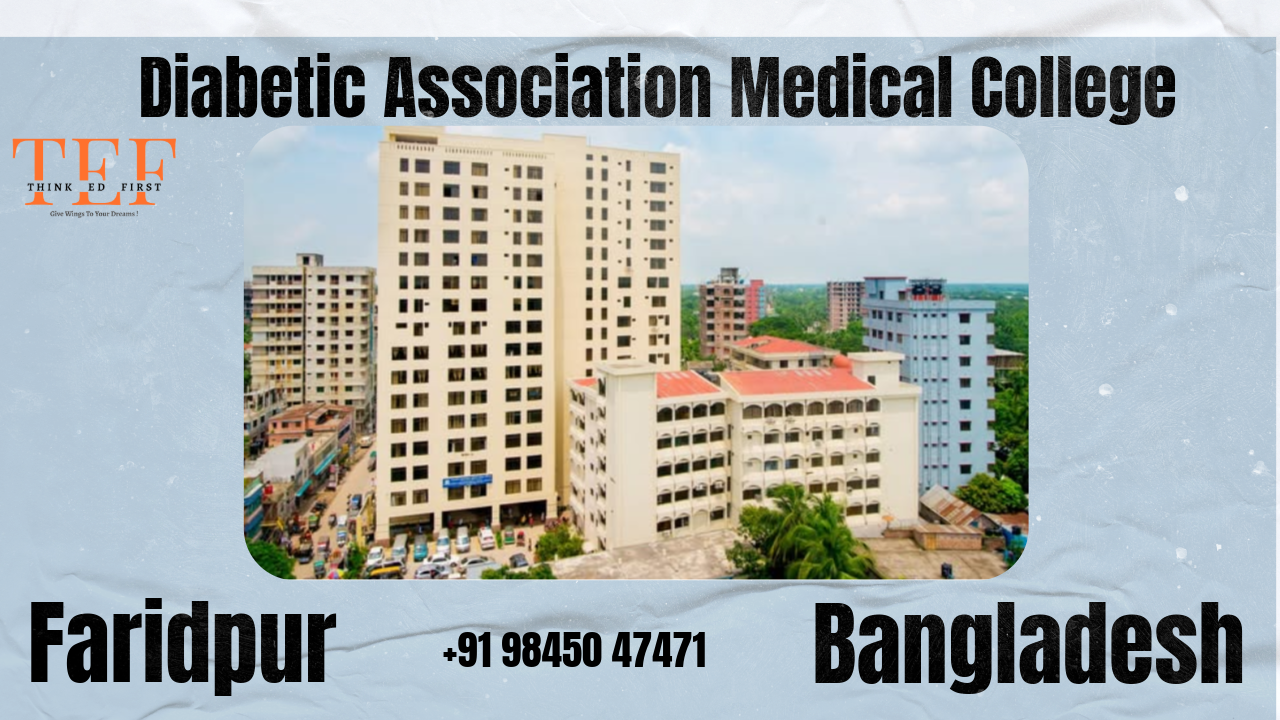
Diabetic Association Medical College and its attached teaching hospital, including campus/aerial views, hospital exterior, hostel and academic facilities.


History of the College
Diabetic Association Medical College, Faridpur was established in 2009 by the Faridpur Diabetic Association Trust. The institution was created with the objective of providing medical education while also contributing to healthcare services in the community.
The college has grown from its initial years into an established medical teaching institution. According to its current website, it has produced 443 MBBS graduates, with 127+ faculty and staff and 16+ student batches listed on the homepage.
The college is associated with the Faridpur Diabetic Association, which has a particular history of providing diabetes-related healthcare services in the region.
Affiliation and Recognition
One of the most important factors for students choosing a medical college abroad is its academic affiliation and regulatory status.
Diabetic Association Medical College states that it is:
- Affiliated with the University of Dhaka
- Recognized by the Bangladesh Medical & Dental Council (BM&DC)
- Approved by the Ministry of Health and Family Welfare, Bangladesh
- Listed in the World Directory of Medical Schools (WDOMS)
- Listed by the college as having international recognition relevant to graduates seeking pathways such as ECFMG certification.
The Directorate General of Medical Education (DGME) also maintains a facility record for Diabetic Association Medical College, Faridpur.
Students should always verify the current recognition, accreditation and eligibility requirements with the relevant regulator in their home country before taking admission.
MBBS Course at Diabetic Association Medical College
The college offers the Bachelor of Medicine and Bachelor of Surgery (MBBS) programme.
According to the college’s published course information:
- Academic study: 5 years
- Mandatory internship: 1 year
- Total training period: 6 years including internship
- Medium: English
- Affiliation: University of Dhaka
- Professional examinations: Conducted through the University of Dhaka
- Degree: MBBS awarded through the University of Dhaka framework. (webdisk.damcf.edu.bd)
The five-year academic programme is followed by compulsory internship training, giving students an opportunity to gain supervised clinical experience.
MBBS Curriculum
The medical curriculum is divided into different phases.
Phase I
Students begin with the basic medical sciences:
- Anatomy
- Physiology
- Biochemistry
These subjects help students understand the structure and normal functioning of the human body.
Phase II
The second phase includes:
- Pharmacology & Therapeutics
- Forensic Medicine & Toxicology
Students learn about medicines, their effects, treatment principles and forensic aspects of medicine.
Phase III
The third phase focuses on:
- Community Medicine & Public Health
- Pathology
- Microbiology
This stage connects basic medical knowledge with disease processes, infection, laboratory medicine and public health.
Phase IV
The final academic phase covers major clinical subjects including:
- Medicine
- Paediatrics
- Psychiatry
- Cardiology
- Neuromedicine
- Gastroenterology & Hepatology
- Endocrinology
- Respiratory Medicine
- Surgery
- Orthopaedics
- ENT
- Ophthalmology
- Urology
- Radiology & Imaging
- Anaesthesiology
- Obstetrics & Gynaecology
- Casualty and emergency-related training
The college’s current website lists these departments and clinical areas as part of its academic structure.
Medium of Instruction
The medium of instruction is English.
This is an important advantage for international students because medical lectures, textbooks, examinations and academic communication can be conducted in English. The college specifically states that its foreign-admission MBBS programme is taught in English.
Students should still expect to learn basic Bengali communication skills because interaction with local patients is an important part of clinical training.
Teaching Hospital: Diabetic Association Medical College Hospital
One of the major features of the college is its attached teaching hospital.
The Diabetic Association Medical College Hospital (DAMCH) began its journey in 1985 and is now described by the college as a 500-bed tertiary-care hospital. It provides services across multiple areas of medicine and functions as a clinical training facility for medical students.
The hospital provides care to both diabetic and non-diabetic patients.
According to the college, the hospital sees approximately 3,000 outdoor patients per day on average, with bed occupancy around 75%. The hospital also states that around 30% of poor patients are treated free of cost.
For an MBBS student, regular exposure to a functioning teaching hospital is important because clinical medicine cannot be learned only from textbooks.
Clinical Exposure for MBBS Students
Clinical exposure is one of the most important parts of medical education.
At Diabetic Association Medical College, students can progress from basic sciences to clinical subjects and eventually participate in bedside learning and hospital-based training.
The college lists facilities such as:
- Bedside teaching facilities
- Skill laboratory
- Practical laboratories
- Cadaver room
- Dissection hall
- Histology practical room
- Labour room
- ICU
- HDU
- CCU
- Procedure and dressing room
- Casualty
- Radiology and imaging facilities
- Clinical departments
These facilities support practical and clinical learning alongside classroom teaching.
Focus on Diabetes and General Healthcare
The name of the institution reflects its connection with the Faridpur Diabetic Association.
This gives the institution a distinctive healthcare background, particularly in diabetes care. At the same time, the attached hospital is described as a full-fledged general and tertiary-care hospital serving both diabetic and non-diabetic patients.
This combination can expose students to both chronic disease management and general clinical medicine.
Students can encounter patients from different backgrounds and with different medical conditions during their clinical education.
Academic Departments
The college has departments covering both pre-clinical and clinical education.
Basic Medical Sciences
- Anatomy
- Physiology
- Biochemistry
Para-clinical Sciences
- Pharmacology & Therapeutics
- Forensic Medicine & Toxicology
- Pathology
- Microbiology
- Community Medicine & Public Health
Clinical Sciences
- Medicine
- Paediatrics
- Surgery
- Obstetrics & Gynaecology
- Psychiatry
- Cardiology
- Neuromedicine
- Endocrinology
- Respiratory Medicine
- Gastroenterology & Hepatology
- Orthopaedics
- ENT
- Ophthalmology
- Urology
- Anaesthesiology
- Radiology & Imaging
- Casualty
The college also has a Medical Education Unit and research-related activities.
Practical and Skill-Based Learning
Modern medical education requires more than lectures.
DAMCF’s current academic structure includes a Skill Lab, practical laboratories, dissection facilities and bedside teaching facilities. The college website also publishes activities related to basic medical skills training.
Skill-based learning can help students develop practical competencies such as:
- Patient examination
- Clinical communication
- Basic procedures
- Medical history taking
- Physical examination
- Interpretation of clinical findings
- Teamwork
- Professional behaviour
The exact procedures and level of student participation depend on the curriculum, clinical department and stage of training.
Admission for Foreign Students
Diabetic Association Medical College has a dedicated foreign admission section.
The college states that foreign applicants need an HSC or equivalent qualification from the Science stream with Biology. Eligibility is determined through the relevant Bangladeshi medical education authorities, with an equivalence/eligibility process for international qualifications.
International students should prepare their academic documents well in advance.
Typical documents may include:
- Passport
- Secondary-school certificates
- Higher-secondary certificates
- Marksheets/transcripts
- Biology, Chemistry and Physics records
- Passport-size photographs
- Medical fitness documents
- Eligibility/equivalence documentation
- Other documents required by DGME/DGHS and the college
The exact document list can change depending on the applicant’s country and admission session.
Fees for Foreign Students
International students is US$42,000.
The current fee structure is:
| Fee Component | Amount |
|---|---|
| Admission Fee | US$21,500 |
| Internship Fee | US$1,900 |
| Tuition Fee for 5 years | US$15,000 |
| AC Hostel for 5 years | US$3,600 |
| Total | US$42,000 |
Published Payment Schedule
- 1st installment: US$15,000 before admission
- 2nd installment: US$9,000 before the second year
- 3rd installment: US$9,000 before the third year
- 4th installment: US$9,000 before the fourth year
- Total: US$42,000
Students should confirm the applicable fee schedule for their specific admission session because fees and payment deadlines can be revised.
Other Expenses
The published foreign-student fee structure does not include every possible personal expense.
According to the college, students need to separately bear:
- Food expenses
- University examination fees
- Study tour fee in the fourth year
- Any accommodation charges after the initial five-year hostel period if they remain in the hostel
The college states that the listed fees are non-refundable.
Therefore, students should prepare a separate budget for food, travel, personal expenses, books, visa-related expenses and other individual costs.
Hostel Facilities
The college provides accommodation options for students, including separate hostel arrangements for boys and girls.
The college’s current website lists:
- Boys’ hostel
- International boys’ hostel
- Girls’ hostel
- International girls’ hostel
Students should confirm room availability, sharing arrangements, facilities and hostel rules before admission.
Student Life at Faridpur
Faridpur offers a different experience from studying in a very large metropolitan city.
Students can focus on academics while living in a relatively quieter environment. At the same time, students have access to the facilities and healthcare ecosystem around the medical college and teaching hospital.
The college also conducts student activities such as sports, cultural programmes, debates and other extracurricular activities. Its current noticeboard shows academic and student activities during 2026.
Library and Academic Resources
Medical students need regular access to textbooks, journals and digital learning resources.
DAMCF lists an academic library and e-library-related resources among its student facilities. The college website also provides access to its journal and library systems.
Students can use these resources for:
- Lecture preparation
- Practical preparation
- Professional examination preparation
- Research
- Assignments
- Medical literature review
Research and Medical Education
The college has a Medical Education Unit (MEU) and a Research & Monitoring Cell.
Its administrative structure also includes committees related to quality assurance, academic coordination, faculty development, research and institutional education.
This is important because medical education is increasingly moving toward competency-based and evidence-informed learning.
Professional Examinations
Students do not simply complete classroom lectures and receive an MBBS degree.
The programme involves professional examinations under the University of Dhaka framework. The college states that the University of Dhaka conducts the professional examinations and awards the MBBS degree.
Students therefore need consistent preparation throughout their academic years.
Internship After MBBS
After completing the five-year academic MBBS programme, students undertake a one-year compulsory internship.
Internship training is an important part of medical education because it provides supervised clinical experience in hospital departments.
The college’s current foreign-admission information also states that during internship training, a trainee is entitled to an appropriate subsistence allowance/honorarium of BDT 20,000 per month, subject to the college’s applicable terms.
Why Consider Diabetic Association Medical College, Faridpur?
There are several factors students may consider when evaluating DAMCF:
1. University of Dhaka affiliation
The MBBS programme is affiliated with the University of Dhaka, one of Bangladesh’s major public universities.
2. English-medium education
The MBBS course for foreign students is conducted in English.
3. Attached teaching hospital
The college has an attached 500-bed tertiary-care teaching hospital.
4. Clinical departments
Students have exposure to a wide range of clinical specialties.
5. International student admission
The college has a dedicated process for foreign applicants.
6. Structured MBBS programme
The programme consists of five academic years followed by compulsory internship.
7. Medical skill facilities
The college lists skill labs, practical facilities, dissection facilities and bedside teaching resources.
Is Diabetic Association Medical College, Faridpur Good for MBBS?
DAMCF can be considered by students looking for an MBBS programme in Bangladesh with University of Dhaka affiliation, English-medium instruction and an attached tertiary-care teaching hospital.
Its long-running medical college and hospital structure provides students with both academic and clinical environments. The 500-bed teaching hospital and its broad range of clinical departments are particularly relevant for students who want regular exposure to hospital medicine.
However, every student should make the final decision after checking the latest regulatory status, eligibility requirements, total cost and clinical training arrangements applicable to their nationality and admission year.
Frequently Asked Questions
Is Diabetic Association Medical College, Faridpur affiliated with the University of Dhaka?
Yes. The college states that its MBBS programme is affiliated with the University of Dhaka.
Is the college recognized by BM&DC?
The college states that it is recognized by the Bangladesh Medical & Dental Council.
What is the duration of MBBS?
The academic MBBS programme is 5 years, followed by 1 year of compulsory internship.
What is the medium of instruction?
The medium of instruction is English.
Does the college accept foreign students?
Yes. The college has a dedicated foreign-admission process.
What is the current published fee for foreign students?
The college currently publishes a total of US$42,000 for the foreign-student package, including admission, internship, tuition and five years of AC hostel accommodation.
Does the college have a teaching hospital?
Yes. Diabetic Association Medical College Hospital is the attached teaching hospital and is described by the college as a 500-bed tertiary-care hospital.
Admission Guidance
If you are planning to study MBBS in Bangladesh and want to know about eligibility, fees, admission procedures, documents, hostel facilities and the latest intake, professional guidance can help you make an informed decision.
For MBBS admission assistance, contact Think Education First.
📞 Call/WhatsApp: +91 98450 47471
The team can assist students and parents with university selection, application guidance, documentation and the admission process.