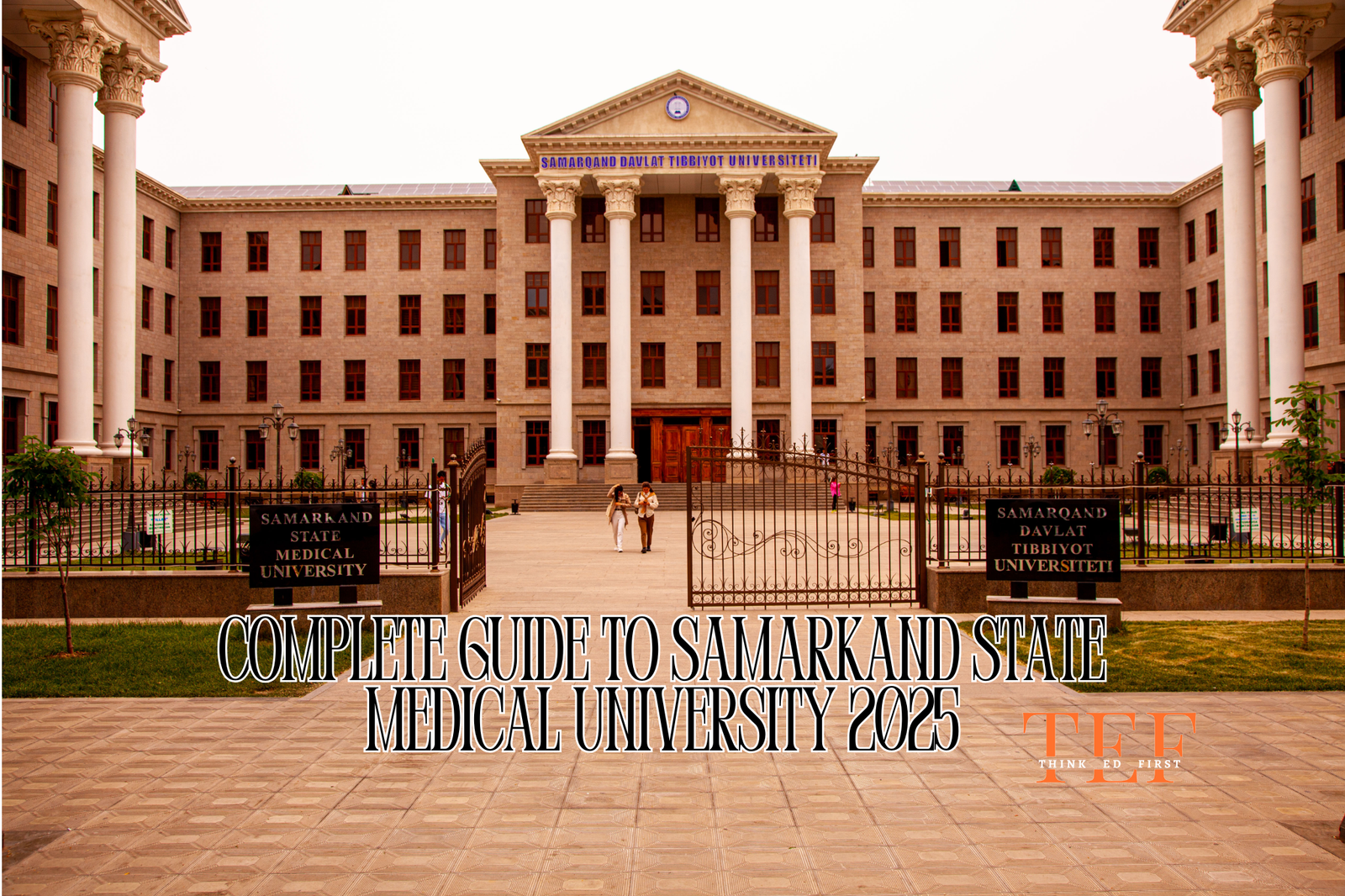
Dreaming of becoming a doctor but concerned about limited seats and sky-high fees in Indian medical colleges? Samarkand State Medical University (SSMU) might be your perfect answer. With over 2,000 Indian students already thriving there, SSMU has established itself as one of Central Asia’s most trusted destinations for MBBS education. This comprehensive guide walks you through everything you need to know about studying MBBS at Samarkand in 2026.
Why Samarkand State Medical University Is a Great Choice
Samarkand State Medical University, established in 1930, is the oldest medical institution in Central Asia. Today, it serves approximately 3,200 international students, with a significant Indian community that makes the transition to student life seamless.
Key Reasons to Choose SSMU
Global Recognition & Accreditation
SSMU holds multiple prestigious recognitions that matter for your future: it’s listed in the World Directory of Medical Schools (WDOMS), approved by the National Medical Commission (NMC), recognized by the World Health Organization (WHO), and certified by FAIMER. Most importantly, it received international institutional accreditation from ECAQA (Eurasian Center for Accreditation and Quality Assurance), valid until 2030—a credential that opens doors to foreign employers and ensures your degree is truly globally marketable.
Affordability Without Compromise
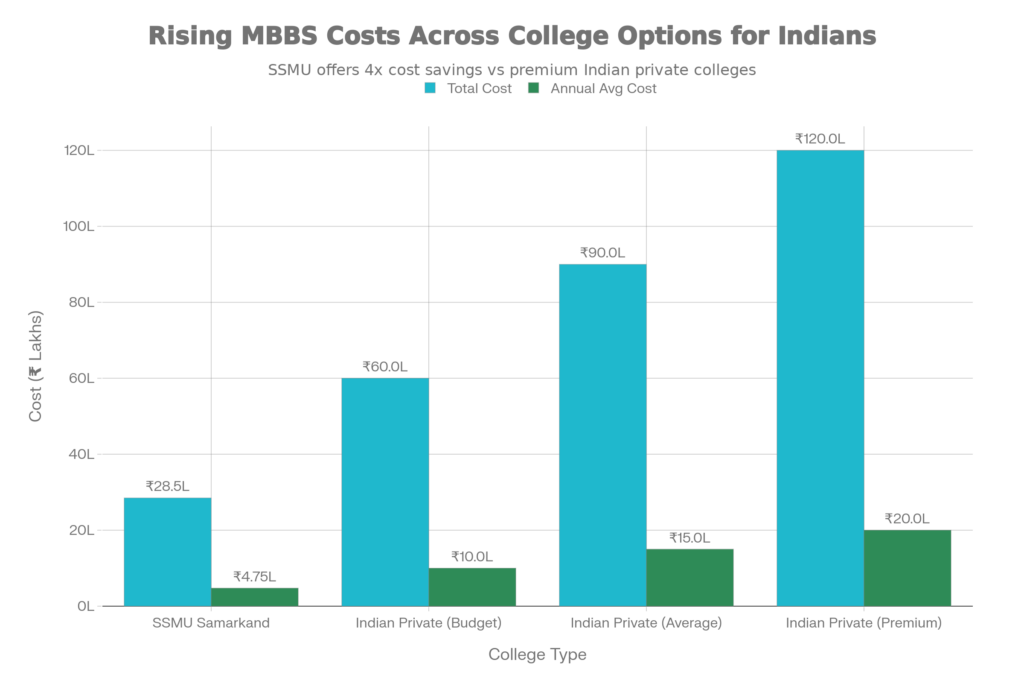
Compared to Indian private medical colleges (₹60 lakh to ₹1.2 crore), SSMU’s total 6-year cost is approximately ₹25-32 lakh, including tuition, accommodation, and living expenses. This cost advantage makes quality medical education accessible to middle-class Indian families.
English-Medium Instruction
Theory classes, exams, and academic materials are entirely in English. This eliminates the language barrier that international students often face, allowing you to focus purely on mastering medical knowledge rather than struggling with unfamiliar terminology.
Strong Indian Community
With over 2,000 Indian students, you won’t feel alone. The university provides dedicated Indian mess facilities with Indian cooks, separate hostel floors for Indians, and a vibrant Indian Students Society. This community support is invaluable during your six-year journey.
Valid for Practice in India
One of the most critical advantages: SSMU graduates can practice medicine in India after clearing the FMGE (Foreign Medical Graduate Examination) or the new NExT exam and registering with the National Medical Commission. The degree is as valid in India as any government medical college degree.
What Makes Samarkand State Medical University Special?
Academic Excellence
SSMU doesn’t just offer affordable education—it delivers quality. The university employs a combination of experienced Indian faculty (a unique advantage among foreign universities) and international educators. The curriculum is NMC-compliant, ensuring that students are prepared not just for their final exams but also for licensing examinations like FMGE.
Modern Infrastructure
The university features state-of-the-art medical laboratories with modern equipment, teaching hospitals with comprehensive clinical exposure, a scientific library with digital resources, e-textbooks, journals, and research papers, computer labs for research and academic work, and modern hostel facilities with high-speed internet and recreational areas.
Cultural & Historical Advantages
Samarkand, a UNESCO World Heritage Site, is one of the world’s most historically significant cities. While studying, you’ll live in a place steeped in ancient Silk Road history, offering cultural enrichment beyond textbooks. The city is also one of the safest in Central Asia, with excellent public transportation and affordable living costs.
Safe Student Environment
The university maintains strict security protocols: 24/7 security personnel in hostels, CCTV surveillance across campus, disciplined entry and exit policies, on-campus medical center for student health needs, and regular health check-ups and awareness programs.
Step-by-Step Guide to Admission in 2026
Step 1: Check Eligibility
Before investing time and effort, confirm you meet SSMU’s requirements:
| Eligibility Criterion | Details |
|---|---|
| Age | Minimum 17 years by December 31, 2026 |
| 12th Marks | 50% aggregate in Physics, Chemistry, Biology (PCB) for general category; 40% for SC/ST/OBC |
| NEET Qualification | Mandatory for Indian students; must qualify in 2026, 2025, or 2024 |
| Educational Background | Class 12 completed with PCB as core subjects |
| English Proficiency | Basic English communication skills required |
Step 2: Prepare Documents
Begin document preparation 4-6 months before your target intake (February or September). Required documents include original Passport (minimum 18 months validity), Class 10th Certificate and Mark Sheet, Class 12th Certificate and Mark Sheet (with all subjects listed), NEET Scorecard (original), Birth Certificate, 6 Passport-size photographs (3.5 x 4.5 cm), and Medical fitness certificate (HIV, TB, Corona tests).
Documentation tips: Get all educational documents notarized and officially translated into Russian or Uzbek if required. Ensure passport has at least one blank page for visa stamping. Keep scanned copies of all documents for online submission. Verify that NEET scorecard clearly shows you’ve qualified. Get medical tests done at certified diagnostic centers recognized by the Uzbek Embassy.
Step 3: Apply Online
SSMU accepts applications year-round, but the admission process intensifies before February and September intakes.
Online Application Process:
- Visit the University Portal and access the international admissions section
- Complete Application Form with personal details, educational background, and program preference
- Upload Documents: Scan and upload all required documents (PDFs, JPG format; typically under 5 MB each)
- Provide Contact Information with your home address, email, and phone numbers
- Pay Application Fee (typically $50-100 USD)
- Submit after reviewing all information carefully—errors can delay processing
Timeline: Allow 2-3 weeks for the university to acknowledge receipt and request any additional information if needed.
Step 4: Get Your Offer Letter
After submitting your application, SSMU’s International Department reviews your credentials. This process typically takes 3-4 weeks.
After interview approval, SSMU issues an official Admission Letter (also called Invitation Letter). This letter is crucial for visa application. Accept the offer and proceed to fee payment. University specifies fee payment deadlines and methods, typically structured as 1st Installment (30-50% upon admission confirmation), 2nd Installment (before visa application), and Remaining Balance (before departure to Uzbekistan).
Step 5: Apply for Visa
With your admission letter in hand, you’re ready for the visa process.
Student Visa : The most common and convenient option. contact Think ED First ; cost is $250 to $300 USD; processing time is 10 – 15 working days (apply 20-30 days before travel to be safe); validity is up to 1 year.
Required Documents for Student Visa: Valid Passport (minimum 365 days validity beyond intended stay), Completed online application form, Recent passport-size color photo (digital upload), Copy of your admission letter from SSMU, and Proof of payment (screenshots or receipts).
Visa Application Steps:
- Gather all required documents
- Visit e-visa.gov.uz or the Uzbekistan Embassy website
- Complete online form with accurate passport details
- Upload photo and documents
- Pay visa fee online (Visa/MasterCard)
- Receive visa confirmation via email
- Print and carry while traveling
Important Notes: Indian citizens cannot use visa-on-arrival; e-visa or student visa is mandatory. Ensure visa validity covers your entire stay. Keep a photocopy of your visa with your important documents. Inform the university about your visa issuance date so they can arrange airport pickup.
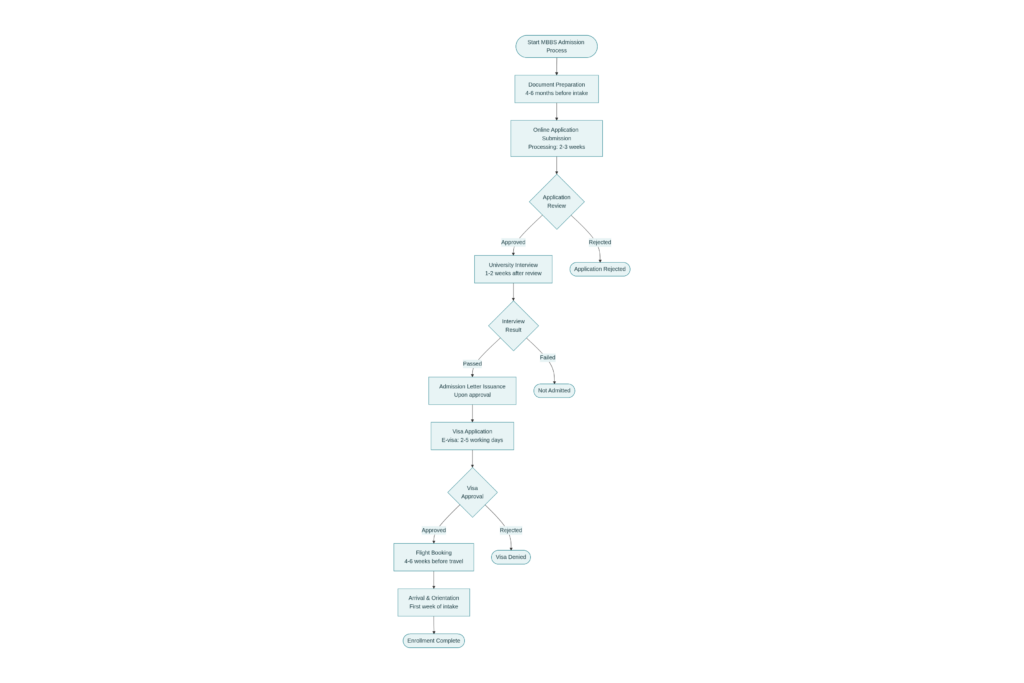
MBBS Admission Timeline and Process Flow for Samarkand State Medical University 2026
Step 6: Book Your Flight and Travel
With visa in hand, you’re on the home stretch!
Flight Booking Tips: Primary destination is Tashkent International Airport (nearest major airport to Samarkand). Book 4-6 weeks before departure for best fares. Airlines like Turkish Airlines, Air India, Uzbekistan Airways, and Flydubai offer good connectivity. Estimated cost: ₹20,000-40,000 (varies by season; cheaper 2-3 months before travel).
Pre-Departure Checklist: Confirm flight tickets and print booking confirmation. Inform SSMU’s International Department of arrival date and flight details. Arrange airport pickup through the university (they often provide this service). Withdraw some cash and inform your bank about travel dates. Purchase travel insurance. Pack essential medications and documents in carry-on luggage.
Journey from Airport to Samarkand: Distance is ~300 km from Tashkent. Travel Options include university-arranged bus, taxi, or flight (45 minutes). Estimated Cost: $20-50 USD depending on transportation mode. Travel Duration: 4-5 hours by road, 45 minutes by flight.
What Will You Study? MBBS Curriculum at Samarkand State Medical University
Samarkand State Medical University offers a comprehensive 6-year MBBS program designed to meet NMC standards and international best practices. The entire curriculum is taught in English, with some clinical subjects in Uzbek or Russian to facilitate patient interaction during internships.
Program Duration & Structure
Total Duration: 6 years (5 years 8 months exactly)
- Preclinical & Paraclinical Years: First 2-3 years
- Clinical Years: Following 2-3 years
- Internship: Final 12 months of mandatory clinical training
This structure fully complies with NMC requirements: minimum 54 months of coursework + 12 months of internship.
Core Medical Subjects Covered
The curriculum encompasses Human Anatomy, Physiology, Biochemistry, Medical Microbiology, Pathology, Pharmacology, Forensic Medicine (preclinical phase); General Medicine, General Surgery, Pediatrics, Obstetrics & Gynecology, Psychiatry, Otolaryngology (ENT), Ophthalmology, Dermatology, Radiology, Emergency Medicine (clinical phase); and clinical rotations across all major departments, hospital-based training, patient care experience, supervised clinical practice, and elective courses based on specialization interests (internship phase).
Teaching Methodology
- Classroom Lectures: Interactive sessions using modern audio-visual aids
- Practical/Laboratory Work: Hands-on experience with specimens and equipment
- Clinical Rounds: Real-world hospital exposure under faculty supervision
- Seminars & Case Studies: Problem-based learning and clinical reasoning
- Research Projects: Encouraged to build research aptitude
Fees and Cost of Living
Understanding the exact financial commitment is crucial before making your decision. Here’s a transparent breakdown:
Annual Fee Structure (2025-26)
| Fee Category | Amount (USD) | Amount (₹) | Remarks |
|---|---|---|---|
| Tuition Fee | $3,500 | ₹3,03,000 | Per year, all 6 years |
| Hostel Fee | $350-600 | ₹30,300-51,600 | Varies by room type; compulsory 1st year |
| Indian Mess Charges | $1,200 | ₹1,04,000 | 1st year only; includes 3 meals daily |
| Visa Extension Fee | $300 | ₹25,500 | From 2nd year onwards, annually |
| Registration & Admin Charges | $250-350 | ₹21,250-29,750 | Annual fee |
| Medical Insurance | $50-100 | ₹4,300-8,600 | Annual health coverage |
| Miscellaneous Charges | $50 | ₹4,325 | Annual utilities, internet, etc. |
Total 6-Year Budget Estimate
| Category | Total (USD) | Total (₹) |
|---|---|---|
| Tuition Fees (6 years) | $21,000 | ₹18,18,000 |
| Hostel Fees (6 years) | $2,100-3,600 | ₹1,81,800-3,12,000 |
| Mess Charges (1st year only) | $1,200 | ₹1,04,000 |
| Visa, Registration, Medical Insurance | $3,000-3,500 | ₹2,59,500-3,02,500 |
| Miscellaneous | $300 | ₹25,950 |
| University-Related Costs | $27,600-29,200 | ₹23,89,250-25,40,450 |
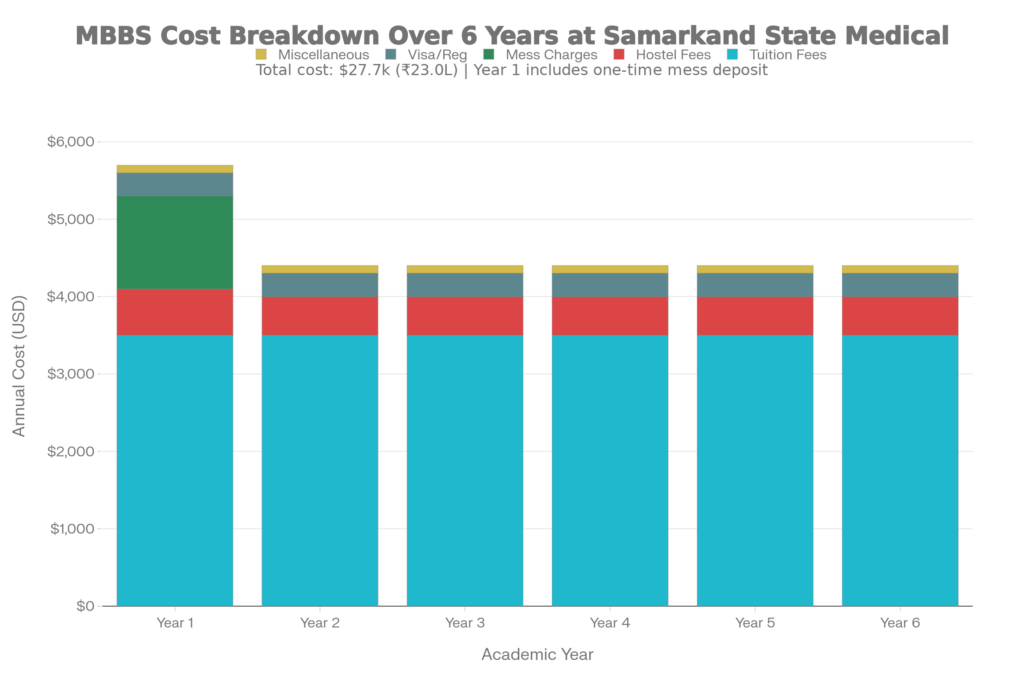
Total 6-Year MBBS Cost Breakdown at Samarkand State Medical University (in USD)
Monthly Cost of Living in Samarkand
Once enrolled, your monthly living expenses depend on lifestyle:
| Expense Category | Monthly Cost (USD) | Monthly Cost (₹) |
|---|---|---|
| Hostel Accommodation (if not included) | $100-150 | ₹8,600-12,900 |
| Food & Dining | $100-120 | ₹8,600-10,300 |
| Transportation | $10-20 | ₹860-1,720 |
| Internet & Phone | $5-10 | ₹430-860 |
| Personal Care & Toiletries | $10-15 | ₹860-1,290 |
| Entertainment & Recreation | $20-30 | ₹1,720-2,580 |
| Books & Study Materials | $10-20 | ₹860-1,720 |
| Miscellaneous | $10-20 | ₹860-1,720 |
| Total Monthly Cost | $155-200 | ₹13,300-17,600 |
Annual Living Expense: Approximately $1,860-2,400 (₹1,59,600-2,07,200)
Cost-saving strategies: Use University Hostel (much cheaper than private rental apartments), Join Indian Mess (planned meals are more economical than eating out), Shop at Local Markets (fresh produce and groceries are inexpensive), Use Public Transport (Samarkand’s bus and taxi system is very affordable), Apply for Scholarships (some universities offer merit-based scholarships: 0-20% tuition waiver), and Study Hours Part-Time (some universities allow students to take part-time local jobs; check regulations).
Life as a Student in Samarkand
Beyond academics, your experience at Samarkand State Medical University will be defined by the rich student life available in this historic city.
Student Accommodation & Hostel Life
Hostel Facilities: The university operates 4 dormitory buildings accommodating 1,300 students. Each hostel is thoughtfully designed for international students with room types (single, double, and triple-occupancy), furnishings (beds, study desks, chairs, wardrobes, and shelving), high-speed Wi-Fi in all rooms and common areas, separate floors for girls and boys ensuring privacy and safety, shared facilities (kitchens, laundry rooms, study lounges, TV rooms), and central cafeteria serving breakfast, lunch, and dinner.
Indian Mess Arrangements: For the first year (compulsory), and optionally thereafter, you can avail the Indian mess facility with Indian Cooks specially employed to prepare authentic Indian cuisine, meal variety (vegetarian and non-vegetarian options daily), proper timing (Breakfast 7-9 AM, Lunch 12-2 PM, Dinner 7-9 PM), special arrangements for Ramadan-specific meals for Muslim students, and cost included in first-year hostel fees (~$1,200/year).
Hostel Safety & Security: Armed security personnel on 24/7 duty, CCTV cameras monitoring entrance and common areas, strict guest policies and entry/exit protocols, emergency medical response team on standby, and warden system with dedicated staff for each floor.
Campus & University Facilities
Academic Facilities: State-of-the-art anatomy and physiology labs, histology and pathology laboratories with modern microscopes, digital library with e-journal and e-book access, computer labs for research and assignments, seminar halls with audiovisual capabilities, and teaching hospital with 1,000+ beds.
Recreational Facilities: Sports complex with badminton, table tennis, and volleyball courts, gym and fitness center, indoor games room, student canteen and cafes, and outdoor green spaces and parks.
Healthcare: On-campus medical center staffed 24/7, basic healthcare services for all students, emergency ambulance service (typically arrives within 20 minutes), health insurance coverage for major illnesses, and tie-ups with leading private hospitals for specialized care.
Samarkand City Life
Historical & Cultural Attractions: Samarkand is one of the world’s most historically significant cities on the ancient Silk Road, featuring Registan (iconic architectural complex of three madrasahs), Shah-i-Zinda (stunning necropolis with blue-tiled tombs), Gur-e-Amir (Mausoleum of Timur/Tamerlane), Ulugh Beg Observatory (historical astronomical complex), and Bibi-Khanym Mosque (one of Central Asia’s largest mosques).
City Features: Population of approximately 500,000 people, Uzbek as primary language (Russian and English widely understood), Uzbek Som currency (1 USD ≈ 12,000-13,000 Som), hot summers (35-40°C) and mild winters (0-5°C), one of Central Asia’s safest cities with low crime rates, and affordable public buses, taxis, and shared vans for transportation.
Social Life: Over 2,000 Indian students create a vibrant community, Indian Students Society organizes cultural programs, sports events, and social gatherings, mosques, temples, and prayer rooms available on campus, bazaars offering local handicrafts, textiles, and international goods, and mix of local Uzbek, Indian, and international cuisine.
Tips for a Smooth Journey
Success at SSMU requires more than just academic aptitude—it demands preparation, adaptability, and smart planning.
Pre-Departure Preparation
Learn Basic Uzbek/Russian: Even though classes are in English, patient interactions during clinical years involve local languages. Duolingo, YouTube, or pre-departure language courses help tremendously. Basic medical terms in Uzbek/Russian accelerate your clinical learning.
Strengthen Your Medical Foundation: Refresh NEET concepts, especially Biology. Biology directly relates to Anatomy, Physiology, and Pathology. Start building good study habits before arrival.
Financial Planning: Open a student bank account in India with international withdrawal facilities. Inform your bank about travel dates to avoid card blocking. Research Uzbekistani banks to open a local account upon arrival. Budget for initial personal expenses (clothes, toiletries, etc.).
Document Organization: Create both physical and digital copies of all important documents. Store originals in a secure locker; carry copies with you. Maintain a digital backup in cloud storage (Google Drive, OneDrive).
Health Checkup: Get a complete medical checkup before departure. Ensure all childhood vaccinations are current. Carry prescriptions and generic names for any regular medications. Pack a basic medical kit (multivitamins, pain relievers, cold medicines).
During Your MBBS Journey
Engage Actively in Studies: Attend all lectures—skipping is common but detrimental to FMGE preparation. Form study groups with Indian classmates for peer learning. Start FMGE preparation from Year 2-3, not just in final year. Use FMGE-specific question banks and mock tests regularly.
Build Clinical Skills Early: Volunteer for clinical rotations beyond mandatory requirements. Develop communication skills with patients (learn local language basics). Seek feedback from senior doctors and faculty. Maintain a portfolio of clinical cases seen.
Balance Academics & Well-being: Don’t isolate yourself; engage with the Indian student community. Participate in cultural events and sports. Maintain physical fitness through regular exercise. Seek counseling if homesickness or academic stress becomes overwhelming.
Develop Strong Writing & Communication Skills: Medical English is precise and formal—practice professional writing. Take advantage of any communication workshops offered. Write case reports and present findings in seminars.
Understand FMGE Requirements Early: Familiarize yourself with FMGE pattern and passing criteria (50% marks). Know that Uzbek curriculum doesn’t perfectly match FMGE—identify gaps. Join online FMGE coaching by reputed Indian educators. Take regular mock tests to assess progress.
Visa & Legal Compliance
Extend Your Visa on Time: Visa extension is handled by the university but requires timely application. Delay in visa extension can result in legal issues and deportation risk. Maintain proper documentation of visa extensions.
Register with Your Embassy: Register with the Embassy of India in Tashkent upon arrival. Keep them informed of any issues or emergencies. Get your passport and documents registered for added safety.
Financial Management
Budget Wisely: Create a monthly budget and stick to it. Avoid excessive spending on entertainment and dining out. Prioritize essentials: accommodation, food, studies.
Avoid Frauds & Scams: Be cautious with unofficial currency exchange. Use ATMs from reputable banks. Don’t share banking details or passwords with anyone.
Prepare for FMGE Financially: FMGE exam fees are approximately ₹12,000-15,000. Budget for exam registration, study materials, and mock tests. Consider coaching fees (₹50,000-200,000 for comprehensive courses).
Mental & Emotional Well-being
Combat Homesickness: Stay connected with family through regular video calls. Join Indian student groups and make friends quickly. Engage in activities you enjoy. Remember: Homesickness is temporary and decreases with time.
Manage Academic Stress: Don’t compare yourself with peers—everyone’s pace is different. Seek help from faculty if struggling with concepts. Break study sessions into manageable chunks. Maintain realistic expectations for exam performance.
Handle Language Barriers: Local language challenges are temporary. Your classmates and senior students will help. Hospital staff are patient with international students. Consistent effort in language learning pays dividends.
Success Rate & Practicality Notes
FMGE Pass Rates: Historically, SSMU’s FMGE pass rate is approximately 12-20%. This is important context—students from top Uzbek universities like Bukhara achieve 47.83% pass rates. Individual success depends heavily on personal preparation and dedication starting early (Year 2-3) rather than waiting until the final year.
Why Some Students Struggle: Curriculum differences between Uzbekistan and India create gaps in specific subjects. Clinical practice involves Uzbek/Russian language interactions, limiting exposure for some students. Success requires active engagement with FMGE-focused coaching alongside regular studies.
Students Who Succeed: Those who start preparation early, join reputed Indian online coaching platforms, maintain discipline throughout 6 years, and choose universities with proven track records significantly increase their chances of passing FMGE on first or second attempt.
Frequently Asked Questions
Q: Is NEET mandatory for SSMU admission?
Yes. The NMC requires NEET qualification for all Indian students pursuing MBBS abroad since 2019. You must have qualified NEET in 2026, 2025, or 2024.
Q: Can I practice in India after MBBS from SSMU?
Yes, but with conditions. After completing MBBS + 1-year internship in Uzbekistan, you must clear FMGE (or NExT) and register with the State Medical Council or NMC.
Q: What is the FMGE pass rate for SSMU?
Historically, SSMU’s FMGE pass rate is approximately 12-20%, which is lower than some other Uzbek universities like Bukhara (47.83%). However, individual success depends on personal preparation and dedication.
Q: Is the degree recognized globally?
Yes. SSMU’s WDOMS listing ensures international recognition. Graduates can pursue medical practice in USA, UK, Middle East, and other countries after passing respective licensing exams (USMLE, PLAB, DHA, HAAD).
Q: Can I do my internship in India?
Internship must be completed in Uzbekistan as per NMC regulations for the degree to be valid. However, after passing FMGE, you can pursue specialized rotations or further training in India.
Q: How safe is Samarkand for Indian students?
Samarkand is considered one of Central Asia’s safest cities. The university maintains strict security measures, and the Indian student community is well-established and supportive.
Q: What if I don’t meet the 50% eligibility in 12th but have a high NEET score?
Contact SSMU’s international office directly. While 50% is the standard criterion, there might be limited flexibility, especially for strong NEET performers. It’s worth asking.
Main Point
Studying MBBS at Samarkand State Medical University is a strategic choice for Indian students seeking affordable, quality medical education with global recognition. With over 2,000 Indian students thriving there, a proven pathway to practice in India, and a supportive community in a historically rich city, SSMU offers more than just a degree—it offers a transformative educational experience.
The journey requires dedication, financial planning, and adaptability, but thousands of Indian students have successfully walked this path. Your success at SSMU depends not on where you study, but on how committed you are to becoming an excellent physician.
Start your application today. Your dream of becoming a doctor is closer than you think.
Important Contact Information: