1. Introduction
Choosing between studying MBBS in Uzbekistan and Russia is a significant decision for Indian students seeking quality medical education abroad. Both countries offer NMC-approved medical universities, affordable fees, and globally recognized degrees. However, the cultural, social, and lifestyle differences between these two nations can significantly impact your student experience.
Uzbekistan, a Central Asian gem with a predominantly Muslim population and rich Islamic heritage, presents a different lifestyle from Russia—a vast Eurasian nation with Orthodox Christian traditions and cosmopolitan urban centers. Understanding these distinctions will help you make an informed choice and prepare effectively for your journey.
This comprehensive guide explores 17 key dimensions of cultural differences between Uzbekistan and Russia from an MBBS student’s perspective.
2. Historical & Cultural Background
Uzbekistan’s Heritage:
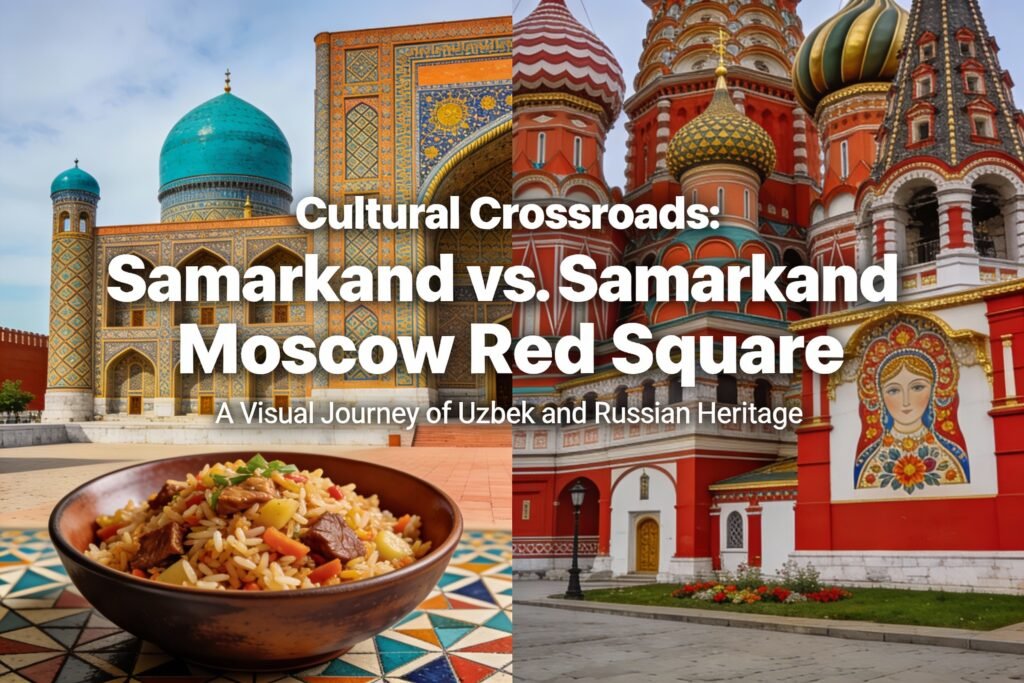
Uzbekistan has a magnificent history spanning over 2,500 years. The country was a crucial crossroads of the ancient Silk Road, home to legendary cities like Samarkand, Bukhara, and Khiva. This heritage is reflected in stunning Islamic architecture, UNESCO World Heritage sites, and a culture deeply influenced by Persian, Turkic, and Central Asian traditions.
The Soviet era profoundly shaped Uzbekistan, introducing Russian language, Soviet education, and modernization. After independence in 1991, the nation began reviving its national identity, emphasizing Uzbek language, Islamic heritage, and traditional values while maintaining secular governance.
Russia’s Heritage:
Russia possesses a complex history influenced by Tsarist imperial rule, Orthodox Christianity, Soviet communism, and post-Soviet transformation. Russian culture is characterized by deep philosophical traditions, classical arts, and a strong emphasis on education and science.
The Soviet legacy remains visible in Russia’s education system, infrastructure, and social values. Post-Soviet Russia has witnessed a resurgence of Orthodox Christianity, traditional values, and nationalist sentiments.
Key Distinction: While both countries share Soviet heritage, Uzbekistan emphasizes its Central Asian and Islamic identity, whereas Russia maintains its European and Orthodox cultural foundations.
3. Language & Communication Style
Uzbekistan:
The official language is Uzbek, a Turkic language using a modified Latin alphabet (since 1992). However, Russian remains widely spoken, especially among older generations and in urban areas.
Most Uzbeks are bilingual (Uzbek + Russian), while many ethnic Russians in Uzbekistan speak only Russian. This creates a linguistic divide where urban educated populations often communicate in Russian but increasingly embrace Uzbek.
Communication Style: Uzbek communication is influenced by Islamic and Central Asian traditions—indirect, respectful of hierarchy, and emphasizing collective harmony. Formal greetings and respectful address are essential.
Russia:
Russian is the official language, and English proficiency varies widely. While younger Russians often speak English, especially in major cities, many older residents speak only Russian.
Communication Style: Russian communication tends to be more direct and formal, with strong emphasis on precision and intellectual rigor. Russians value emotional authenticity in close relationships but maintain professional distance initially.
For MBBS Students: Expect to learn Uzbek or Russian during your studies. Medical terminology in both countries is international, but daily communication requires language proficiency. Uzbekistan offers more cultural immersion with Uzbek language, while Russia provides better international (English) opportunities.
4. Religion & Social Values
Uzbekistan’s Religious Landscape:
Approximately 88-96% of Uzbekistan’s population identifies as Muslim, predominantly Sunni Islam. However, this is more cultural than strictly observant. The government promotes a secular, moderate form of Islam, and religious practice varies widely.
Islamic Influence on Values:
- Family Honor: Central to Uzbek society; family reputation deeply influences personal decisions
- Respect for Elders: Hierarchical respect is fundamental
- Community Orientation: Mahalla (neighborhood communities) provide social support and guidance
- Modest Behavior: Expected in public, particularly for women
- Ramadan Observance: Wide celebration of Islamic holidays, though participation varies
Russia’s Religious Landscape:
Russia is predominantly Orthodox Christian (approximately 65-70% identify as Orthodox, though many are non-practicing). The post-Soviet period has witnessed renewed interest in Orthodox traditions.
Orthodox Christian Values:
- Individual Achievement: Emphasis on personal accomplishment and intellectual merit
- Romantic Idealism: Strong values around love, passion, and philosophical introspection
- Secularism: Religion is personal; public life is secular
- Education & Culture: High regard for literature, arts, and scientific knowledge
Important Note for Students: Uzbekistan’s Islamic values don’t necessarily mean strict religious enforcement. Many Uzbeks drink alcohol and live modern lifestyles. Similarly, Russia’s Orthodox heritage doesn’t dictate daily life for most citizens. Both countries are increasingly secular, especially among younger generations.
5. Weather Conditions & Lifestyle Impact
Uzbekistan’s Climate:
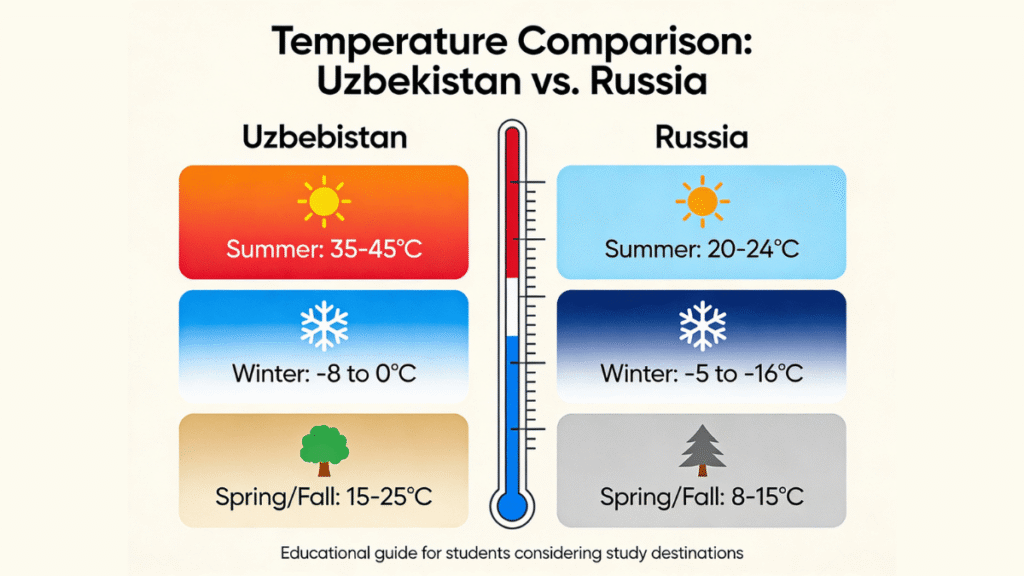
Uzbekistan experiences an extreme continental desert climate with dramatic seasonal variations.
| Season | Temperature | Characteristics |
|---|---|---|
| Winter (Dec-Feb) | -8°C to 0°C (some areas -35°C) | Occasional snow, dry, requires heating |
| Spring (Mar-May) | 14-27°C | Windy, variable, sudden temperature changes |
| Summer (Jun-Aug) | 33-45°C+ | Extremely hot and dry, intense UV radiation |
| Autumn (Sep-Nov) | 12-21°C | Pleasant, moderate temperatures |
Lifestyle Impact: Summer heat forces siestas and indoor activities in afternoons. Locals adapt with late-night socializing and early morning routines. Heavy winter clothing is essential for northern regions.
Russia’s Climate:
Russia has a continental to subarctic climate with severe seasonal extremes.
| Season | Temperature | Characteristics |
|---|---|---|
| Winter (Dec-Feb) | -5 to -16°C Moscow area | Heavy snow, icy conditions, 1-2 hours daylight in far north |
| Spring (Mar-May) | 0 to 20°C | Unpredictable, slow warming, still snowy |
| Summer (Jun-Aug) | 20-24°C | Brief, moderate warmth, midnight sun in north |
| Autumn (Sep-Nov) | 0 to 16°C | Short, rapidly cooling, early darkness |
Lifestyle Impact: Winter dominates Russian culture—ice skating, sledding, and sauna (banya) culture are essential. Long winter nights affect mood and lifestyle. Spring and autumn are brief transitions.
For MBBS Students: Uzbekistan’s heat is more tolerable for many Indian students accustomed to tropical climates, while Russia’s severe winters require significant adaptation. Both require substantial wardrobe adjustments.
6. Food Culture & Halal Availability
Uzbekistan’s Culinary Tradition:
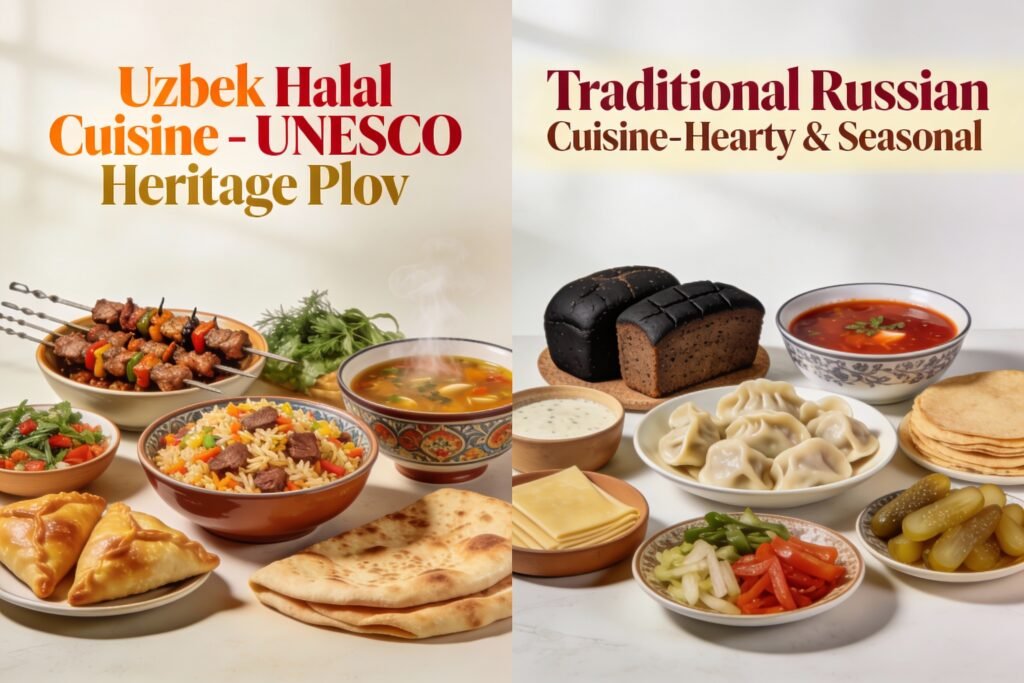
Uzbek cuisine is UNESCO-recognized intangible cultural heritage, blending Silk Road influences with Central Asian authenticity.
Signature Dishes:
| Dish | Description | Halal Status |
|---|---|---|
| Plov (Pilaf) | Rice, meat, carrots, onions with aromatic spices—the national dish | ✓ Halal |
| Shurpa | Hearty meat and vegetable soup | ✓ Halal |
| Shashlik | Skewered lamb, beef, or chicken kebabs | ✓ Halal |
| Manti | Steamed dumplings with meat filling | ✓ Halal |
| Dolma | Stuffed vegetable rolls with meat and rice | ✓ Halal |
| Samsa | Fried pastry with meat filling | ✓ Halal |
| Halva | Dense sesame seed or flour-based dessert | ✓ Halal |
| Non | Traditional flatbread, served with every meal | ✓ Halal |
Halal Availability: Since 96% of Uzbekistan’s population is Muslim, halal food is ubiquitous and easy to find. All meat sold is typically halal-compliant, and most restaurants serve traditional halal cuisine. However, formal halal certification is limited, and some upscale restaurants serve alcohol alongside halal dishes.
Dining Culture: Food is central to Uzbek hospitality. Meals are communal, with plov traditionally served from one large plate shared among diners. Tea (served in small bowls) is offered constantly.
Russia’s Culinary Tradition:
Russian cuisine centers on bread, preserved foods, soups, and hearty peasant traditions.
Signature Dishes:
- Black Bread: Dense, dark bread eaten with every meal
- Borscht: Beet and cabbage soup, iconic Russian dish
- Pelmeni: Meat dumplings, Russian staple
- Blini: Thin pancakes with various toppings
- Pickled Vegetables: Preserved foods from long winters
- Caviar & Smoked Fish: Delicacies for special occasions
Halal Availability: Russia’s Muslim population is small (approximately 10-15%), primarily Tatars and Caucasian minorities. Halal food is difficult to find outside Moscow and major cities. Muslim students often cook their own meals or gather in specific communities.
Dining Culture: Russian meals are structured, formal, and accompanied by vodka (though this is changing with younger generations). Tea is served in glasses with metal holders.
For MBBS Students: Uzbekistan offers significantly better halal food availability and aligns better with Indian dietary preferences. Many Indian students find Uzbek food more palatable than Russian cuisine.
7. Drink Habits Among Students
Uzbekistan’s Drinking Culture:
Uzbekistan’s relationship with alcohol is complex and regionally varied. Historically influenced by both Islamic prohibition and Soviet drinking traditions.
Drinking Patterns:
- Men: Alcohol consumption is socially normalized among adult males in many regions, though varying by tradition and religiosity
- Women: Consuming alcohol is strongly discouraged and viewed as culturally inappropriate
- Youth: Drinking is discouraged for teenagers and young adults, particularly women
- Regional Variation: Western Uzbekistan (Samarkand, Bukhara) more liberal; Fergana Valley more conservative and religiously strict
University Environment: MBBS students are expected to maintain discipline. Universities have strict codes prohibiting alcohol, drugs, and intoxicating substances on campus. However, off-campus socializing varies; some students drink in private settings, while others abstain.
Russia’s Drinking Culture:
Russia has historically been associated with heavy vodka consumption, though recent trends show significant changes.
Recent Trends:
- Youth Sobriety: Alcohol consumption among young Russians (14-22 years) decreased dramatically from 62.1% (2006) to 26.9% (2019)
- Preference Shift: Younger generation prefers beer and wine over vodka
- Growing Abstinence: Non-drinkers increased from 25.4% to 55% among under-25s
University Environment: While alcohol is legally available, Russian universities emphasize academic rigor and discipline. Heavy drinking is associated with academic failure and expulsion. Many students prioritize studies over party culture.
Important Note: Both countries’ younger generations are increasingly health-conscious and less interested in alcohol than stereotypes suggest.
8. Mixing Culture Between Boys and Girls
Uzbekistan’s Gender Dynamics:
Uzbekistan maintains traditional gender norms influenced by Islamic values and patriarchal culture, though modernization is challenging these patterns, especially in urban areas.
Social Norms:
- Segregation: Traditional separation of social spaces for men and women is common in conservative areas
- Handshakes: Men and women typically don’t shake hands; verbal greetings preferred
- Dating: Traditional arranged marriages remain common; love marriages increasing in urban areas
- Respect for Family: Family approval is crucial; premarital relationships are discouraged
- Public Behavior: Displays of affection between unmarried couples are socially inappropriate
Campus Life: Medical colleges have strict codes regulating student interaction. Boys and girls typically have separate hostel accommodations. Mixing is permitted in academic and organized social settings but monitored to maintain discipline.
Russia’s Gender Dynamics:
Russia is experiencing a generational shift in gender relations. Traditional patriarchal values coexist with modern egalitarianism, particularly among urban youth.
Social Norms:
- Free Mixing: Men and women interact freely in social and professional settings
- Dating Freedom: Young people date freely; relationships are personal choices
- Modern Urban Areas: Moscow and St. Petersburg show more progressive gender dynamics
- Traditional Values Resurgence: Conservative segments promote “traditional values” emphasizing distinct gender roles
- Professional Equality: Women are highly educated and career-focused; many out-earn male counterparts
Campus Life: Universities have no restrictions on boy-girl interactions. Hostel accommodation policies vary but generally allow freedom. Students socialize freely in campus clubs, libraries, and public spaces.
For MBBS Students: Uzbekistan requires cultural sensitivity regarding gender interactions. Russia offers more social freedom but can feel overwhelming for students from conservative backgrounds.
9. Living Relationships & Social Freedom
Uzbekistan’s Relationship Culture:
Living together unmarried is socially unacceptable and contradicts Islamic and traditional values. Premarital relationships face significant social stigma.
Social Expectations:
- Marriage as Commitment: Relationships are expected to lead to marriage
- Family Involvement: Parents have significant influence over relationship choices
- Religious Constraints: Islam discourages premarital cohabitation
- Social Pressure: Community and mahalla monitor behavior and maintain moral standards
- Consequences: Relationships violating norms can damage family honor and social standing
Dating Reality: Despite traditional values, younger urban populations engage in premarital dating, but discreetly. Long-term relationships exist in private settings but aren’t publicly acknowledged until marriage is planned.
MBBS Student Experience: Many students maintain relationships but keep them private. Public displays of affection are limited. Hostel rules strictly separate boys and girls.
Russia’s Relationship Culture:
Russia allows complete freedom in personal relationships. Cohabitation, dating, and various relationship types are socially accepted.
Social Norms:
- Personal Choice: Relationship decisions are entirely individual
- Cohabitation Common: Living together before marriage is standard and socially acceptable
- Diverse Relationship Types: Various relationship arrangements are tolerated
- Individual Freedom: No community interference in personal matters
- Practical Approach: Relationships are viewed pragmatically rather than romantically idealized
MBBS Student Experience: Students enjoy complete freedom in dating and relationships. No restrictions on opposite-gender friendships or relationships. Public displays of affection are normal.
For MBBS Students: Consider your comfort level with social freedom. Uzbekistan requires respecting traditional values; Russia offers unrestricted personal autonomy.
10. Sex & Student Community Culture
Uzbekistan’s Approach:
Sexual relationships outside marriage are strongly discouraged by Islamic values and traditional culture. This is a sensitive topic discussed openly only within family or close relationships.
Reality for Students:
- Conservative Official Stance: Universities and society maintain conservative positions
- Private Reality: Some students engage in relationships away from public view
- Gender Double Standard: More acceptance of male relationships than female relationships
- Consequences: Violations can result in social ostracism, family disputes, or academic discipline
- Limited Sex Education: Schools provide minimal comprehensive sex education
MBBS Student Experience: Medical students study reproductive health academically but face social restrictions on personal behavior. Discretion is essential. Relationships are kept private.
Russia’s Approach:
Russia has liberal attitudes toward sexuality. Comprehensive sex education exists in schools, and sexual relationships are personal choices.
Reality for Students:
- Individual Choice: Sexual relationships are entirely personal decisions
- No Social Stigma: Premarital sexual activity is socially accepted
- Sexual Education: Medical curriculum includes comprehensive reproductive health education
- Support Services: Universities provide counseling and health services
- LGBTQ+ Status: Russia’s official stance is extremely anti-LGBTQ+, with legal prohibitions on same-sex relationships and LGBTQ+ expression
MBBS Student Experience: Medical students study human sexuality and reproductive health openly. Personal relationships and sexual choices are entirely private matters.
Important Note: Both countries have regressive attitudes toward LGBTQ+ individuals. Uzbekistan criminalizes same-sex relationships, and Russia has increasingly hostile laws against LGBTQ+ rights.
11. Family System & Moral Expectations
Uzbekistan’s Family Structure:
The family is the cornerstone of Uzbek society. Extended families often live together or in close proximity, providing mutual support and maintaining collective values.
Family System Characteristics:
- Patriarchal: Father/eldest male is head; major decisions are his prerogative
- Extended Family: Grandparents, aunts, uncles actively participate in child-rearing and family decisions
- Collective Orientation: Family interests supersede individual desires
- Respect for Elders: Hierarchical respect for older generations is mandatory
- Female Responsibility: Women manage household; honor preservation is their moral duty
- Marriage Timing: Early marriages (especially for girls) remain common despite legal restrictions
Moral Expectations for Students:
- Academic Focus: Parents expect dedication to medical studies
- Cultural Representation: Students represent family honor
- Respect for Traditions: Expected to maintain cultural values abroad
- Regular Family Contact: Frequent communication with family is expected
- Appropriate Behavior: Any behavior damaging family reputation causes shame (sharm)
Living Arrangements: Students typically live in university hostels but maintain strong family ties. Marriage is the expected pathway for serious relationships.
Russia’s Family Structure:
Russian families are typically nuclear (parents and children), though extended family relationships exist. The family remains important but is less hierarchical than traditional models.
Family System Characteristics:
- Evolving Gender Roles: While traditional patriarchy exists, women increasingly share decision-making
- Nuclear Family: Grandparents less involved in daily parenting
- Individual Autonomy: Children are encouraged toward independence and self-reliance
- Emotional Closeness: Strong emotional bonds despite independent living
- Education Priority: Educational achievement is highly valued and supported
- Later Marriages: Marriage typically occurs in late 20s after education and career establishment
Moral Expectations for Students:
- Academic Excellence: High expectations for scholarly achievement
- Personal Development: Focus on individual growth and career building
- Independence: Expected to solve problems autonomously
- Self-Reliance: Less family interference in personal choices
- Contribution to Society: Emphasis on social responsibility and contribution
Living Arrangements: Students commonly live independently in hostels or rented apartments. Parental support is financial and emotional rather than controlling.
For MBBS Students: Understand that family expectations differ significantly. Uzbek students face stronger moral obligations to family honor; Russian students enjoy more personal autonomy.
12. Education System Overview
Uzbekistan’s Education Structure:
Post-independence Uzbekistan reformed its education system, transitioning from Soviet centralized control to a nationally-focused model emphasizing Uzbek language and culture.
Education System:
- Duration: 12 years compulsory education (primary + secondary)
- Language: All instruction in Uzbek (though Russian available in some schools)
- Curriculum: Heavy emphasis on Uzbek history, culture, and language; Islamic studies reintroduced
- Higher Education: Universities operate under national curriculum standards
- Literacy Rate: 98% literacy rate among adults
Characteristics:
- Centralized: Government controls curriculum and standards
- Reform-Oriented: Post-Soviet reforms emphasize innovation alongside tradition
- University System: Mix of state and private institutions; growing international partnerships
- Entrance Exams: National entrance examinations determine university admission
Russia’s Education Structure:
Russia maintains a highly respected, rigorous education system with roots in Soviet excellence.
Education System:
- Duration: 11-12 years schooling before higher education
- Language: Russian instruction with foreign language options
- Curriculum: Strong emphasis on mathematics, sciences, literature, and humanities
- Higher Education: Prestigious universities with international standards
- Literacy Rate: 99.7% literacy rate (one of world’s highest)
Characteristics:
- Rigorous & Demanding: Known for high academic standards and challenging curricula
- STEM Excellence: Particularly strong in mathematics, physics, engineering
- Soviet Legacy: Continues emphasis on broad knowledge across disciplines
- Competitive Entrance: Unified State Examination (USE) highly competitive
- Free Higher Education: Limited state-funded places available; competitive selection
For MBBS Students: Both systems produce qualified doctors. Uzbekistan offers cultural immersion; Russia provides internationally recognized credentials with higher academic rigor.
13. Education Quality in MBBS
Uzbekistan’s MBBS Program:
Universities in Uzbekistan offer NMC and WHO-approved MBBS programs. The curriculum is modern with increasing emphasis on practical clinical training.
Program Structure:
- Duration: 6 years (5 years academic + 1 year internship)
- Language of Instruction: English
- Curriculum: First 3 years basic sciences; final 3 years clinical rotation
- Clinical Exposure: Early clinical exposure with hospital rotations in year 2
- Recognition: NMC-approved; ECFMGE and WHO recognized
- Faculty: Mix of local specialists and international visiting faculty
Top Universities:
- Samarkand State Medical University (founded 1918)
- Bukhara State Medical Institute
- Tashkent Medical Academy
- Andijhan State Medical Institute
- Nukus State Medical Institute
Strengths:
- Affordable fees (₹2.5-5 lakhs/year)
- Safe, stable environment
- Cultural similarity to India (similar values, food preferences)
- Early clinical exposure
- Small class sizes; personalized attention
Challenges:
- Limited English language support
- Less research opportunities compared to Russia
- Infrastructure varies by university
- Limited diversity in international student body
Russia’s MBBS Program:
Russia’s medical education is world-renowned for rigor and practical training. Over 50 NMC-approved universities exist across Russia.
Program Structure:
- Duration: 6 years (3 years basic sciences + 3 years clinical)
- Language: English medium instruction
- Curriculum: Rigorous basic sciences followed by intensive clinical training
- Clinical Exposure: Approximately 70% curriculum is clinical practice
- Recognition: WHO, NMC, WFME, ECFMG recognized
- Faculty: Highly qualified specialists with research expertise
Top Universities:
- Pavlov First Saint Petersburg State Medical University
- Sechenov University (Moscow)
- Lomonosov Moscow State University
- Kazan Federal University
- Bashkir State Medical University
Strengths:
- World-class medical education with strong research component
- Extensive hospital networks for clinical training
- High FMGE passing rates (80-90%)
- Access to cutting-edge medical knowledge
- Strong international collaboration
- Superior English language support
Challenges:
- Harsh winters affect lifestyle
- Cultural distance from India
- Less familiar food and lifestyle
- Higher living costs in major cities
- Cultural discrimination incidents reported
For MBBS Students: Uzbekistan offers accessible, quality education in a familiar cultural setting. Russia provides superior academic rigor and international standing but requires greater cultural adaptation.
14. Campus Life & Student Discipline
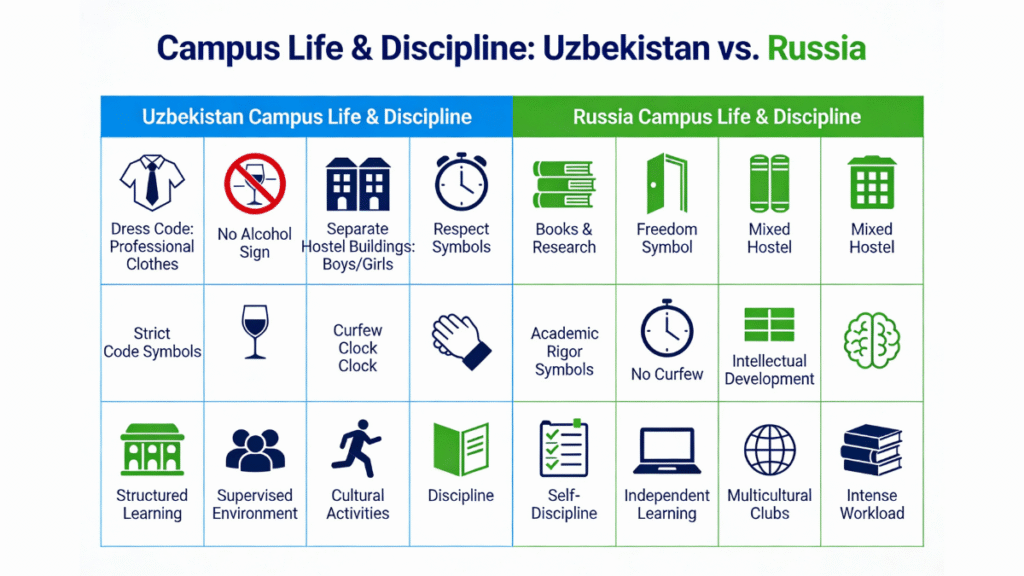
Uzbekistan’s Campus Environment:
MBBS universities in Uzbekistan maintain disciplined, structured campus environments aligned with Islamic and traditional values.
Discipline Code Highlights:
- Dress Code: Professional, modest clothing required on campus
- Conduct: Strict prohibition on alcohol, drugs, and intoxicating substances
- Gender Separation: Separate hostel accommodations for boys and girls
- Punctuality: Mandatory attendance and punctual class arrival
- Respect: Required respect for teachers and institutional hierarchy
- Prohibited Behavior: Violence, obscenity, harassment strictly forbidden
- Curfew: Hostel curfews enforced; late-night outings regulated
Campus Life:
- Academic Focus: Strong emphasis on studies; limited party culture
- Social Activities: Organized student clubs, sports, cultural events
- Hostel Living: Shared rooms (2-3 students); supervised by wardens
- Facilities: Basic but adequate; Wi-Fi, library, sports complexes available
- Religious Activities: Prayer facilities available; Ramadan widely observed
- Community: Close-knit student community; cultural and regional clubs
Student Experience: Life is structured and disciplined. Students balance rigorous academics with cultural activities. Medical training begins early with hospital exposure.
Russia’s Campus Environment:
Russian universities prioritize academic excellence and intellectual development. Discipline is maintained through high standards rather than strict rules.
Discipline Characteristics:
- Academic Standards: High expectations; underperformance leads to expulsion
- Self-Discipline: Students expected to manage own learning
- Minimal Rules: Few restrictions on personal behavior
- No Gender Separation: Co-ed hostel arrangements (room assignments vary)
- Freedom: High personal freedom in lifestyle choices
- Workload: Intense academic workload (9-5+ study days)
Campus Life:
- Intellectual Environment: Focus on learning, research, critical thinking
- Student Activities: Academic clubs, sports, cultural organizations
- Hostel Living: Shared accommodations (2-3 students); unsupervised
- Facilities: Modern libraries, labs, sports centers
- Social Life: Limited compared to Western universities; focused on studies
- Diversity: Multicultural environment with international students
Student Experience: Life is academically intense. Students from other CIS countries (including Uzbekistan) report easier integration; foreign students sometimes face discrimination.
For MBBS Students: Uzbekistan offers a structured, safe environment with clear behavioral expectations. Russia offers intellectual freedom but demands higher academic performance and adaptation to cultural differences.
15. Interaction With International Students
Uzbekistan’s International Student Environment:
Uzbekistan has become the third-largest source of internationally mobile students globally, indicating strong international education presence.
International Student Experience:
- Welcome Environment: International students generally welcomed
- Support Systems: International student offices provide guidance
- Limited Diversity: Majority of foreign students are from India, Pakistan, Afghanistan
- Communication: Shared English medium helps communication
- Social Integration: Easy cultural integration for Indian students due to similarities
- Community Support: Indian student associations and diaspora communities helpful
- Safety: Uzbekistan considered safe for international students
Challenges:
- Language Barrier: Limited English outside academic settings
- Cultural Distance: Non-Muslim international students may feel isolated
- Healthcare Access: Medical services adequate but differ from Indian standards
- Bureaucracy: Visa and registration processes can be tedious
Student Testimonials: Indian students report comfortable adjustment in Uzbekistan due to cultural and religious similarities, affordable living, and warm hospitality.
Russia’s International Student Environment:
Russia attracts students from 160+ countries, creating a genuinely multicultural environment.
International Student Experience:
- Multicultural Campus: Diversity of nationalities and cultures
- Support Services: International student centers; English-language support
- Stereotyping Exists: Students report stereotyping based on nationality
- Discrimination Incidents: CIS students (including Uzbeks) report discrimination from older Russians
- Chinese Students: Face particular stereotyping and occasional hostility
- CIS Advantage: Students from former Soviet republics find easier integration than other foreigners
- Community Support: International student organizations and diaspora communities available
Challenges:
- Xenophobia: Underlying racism against Central Asians, particularly Uzbeks
- Bureaucracy: Complex registration and visa processes
- Housing Discrimination: Many landlords refuse to rent to foreigners
- Language Essential: Russian proficiency crucial for daily life
- Cultural Distance: Significant adjustment required for non-Russian students
Safety Concerns:
- CIS Students: Generally safe; may face occasional discrimination
- Asian Students: Report higher levels of scrutiny and suspicion
- Discrimination Timeline: Increased tensions post-2022 due to Ukraine conflict
Student Testimonials: Uzbek student in St. Petersburg reported both achievements and challenges, including discrimination, housing difficulties, and security concerns, but ultimately found the experience enriching.
For MBBS Students: Uzbekistan offers smoother integration for Indian students. Russia provides exposure to genuine internationalism but requires resilience against occasional discrimination and cultural barriers.
16. Key Similarities Between Uzbekistan and Russia
Despite differences, both countries share important commonalities benefiting MBBS students:
| Similarity | Details |
|---|---|
| Medical Education Standards | Both offer NMC, WHO, WFME recognized degrees; both meet international medical education standards |
| Affordable Education | Compared to Western countries, both offer economical medical education for Indian students |
| Soviet Infrastructure Legacy | Both maintain strong educational infrastructure from Soviet era; reliable university systems |
| Scientific Excellence | Strong tradition of scientific research and rigorous medical training |
| Safe Cities | Major cities (Tashkent, Samarkand, Moscow, St. Petersburg) are relatively safe for students |
| Hostel Facilities | Both provide student accommodations with basic amenities; supervised environments |
| No Entrance Exams | Both accept NEET qualification; no additional entrance examinations required |
| 6-Year Program | Both offer standard 6-year MBBS with 1-year internship |
| English Medium | Medical instruction available in English at most universities |
| Post-Graduation Opportunities | Graduates eligible for further specialization and practice globally |
| Cultural Respect | Both countries respect international students and maintain religious diversity |
| Student Support Systems | Both have international student offices and counseling services |
17. MBBS Course Total Cost
Uzbekistan MBBS Total Cost:
| Cost Component | Amount (USD) | Amount (INR) |
|---|---|---|
| Tuition (Year 1) | $3,500-4,500 | ₹2.9-3.8 lakhs |
| Tuition (Years 2-6) | $3,200-3,850/year | ₹2.65-3.2 lakhs/year |
| Hostel Fee (Year 1) | $600-800 | ₹50,000-65,000 |
| Hostel Fee (Years 2-6) | $400-800/year | ₹33,000-65,000/year |
| Total 6-Year Tuition | $20,000-26,000 | ₹16.5-21.5 lakhs |
| Total 6-Year Hostel | $3,000-4,000 | ₹2.5-3.3 lakhs |
| Living Expenses (Monthly) | $200-300 | ₹16,500-25,000 |
| Living Expenses (6 Years) | $14,400-21,600 | ₹1.2-1.8 lakhs |
| **TOTAL 6-YEAR COST (approx.) | $37,400-51,600 | ₹20-26 lakhs |
Top Universities & Fees (Uzbekistan):
| University | 1st Year (USD) | Subsequent Years (USD) | Total (INR) |
|---|---|---|---|
| Samarkand State Medical University | $3,850 | $3,850 | ₹25.7 lakhs |
| Bukhara State Medical Institute | $3,200 | $3,200 | ₹23.2 lakhs |
| Tashkent Medical Academy | $4,500 | $3,500 | ₹28.5 lakhs |
| Andijhan State Medical Institute | $6,000 | $4,950 | ₹26.1 lakhs |
| Fergana Medical Institute | $5,800 | $4,750 | ₹25.1 lakhs |
Russia MBBS Total Cost:
| Cost Component | Amount (USD) | Amount (INR) |
|---|---|---|
| Tuition (6 years) | $25,000-35,000 | ₹20.6-28.9 lakhs |
| Hostel Fee (6 years) | $3,600-4,800 | ₹3-4 lakhs |
| Living Expenses (Monthly) | $300-500 | ₹25,000-41,000 |
| Living Expenses (6 Years) | $21,600-36,000 | ₹1.8-3 lakhs |
| **TOTAL 6-YEAR COST (approx.) | $50,200-75,800 | ₹41.4-61 lakhs |
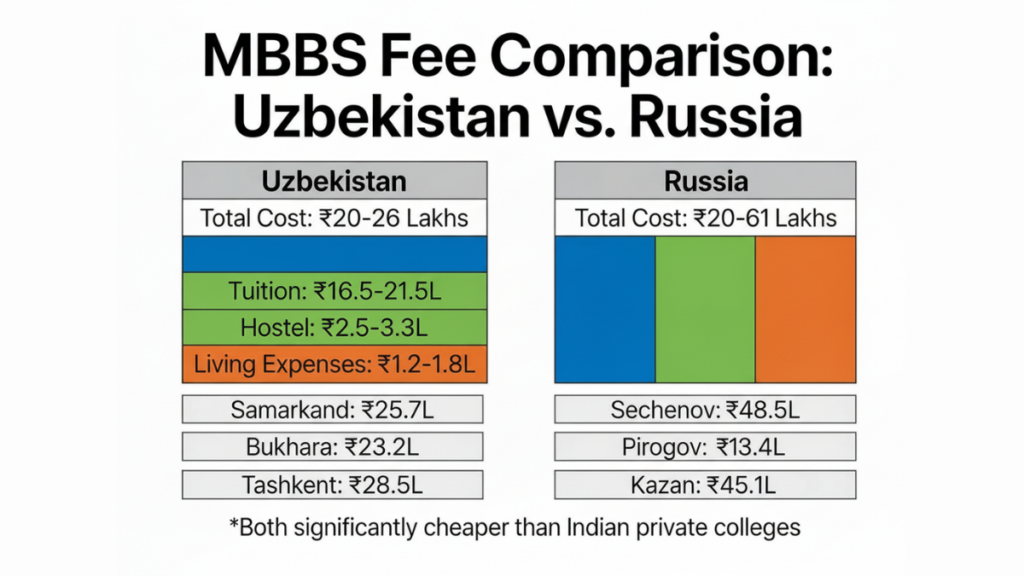
Cost Comparison:
- Uzbekistan: More affordable (₹20-26 lakhs total)
- Russia: Moderate cost (₹41-61 lakhs total)
- Both: Significantly cheaper than private medical colleges in India or Western countries
Cost-Saving Tips:
- Uzbekistan: Minimal living expenses; very affordable daily costs
- Russia: Moscow/St. Petersburg expensive; smaller cities like Kazan cheaper
- Both: Hostel living significantly cheaper than private accommodation
- Consider currency fluctuations when calculating costs
Conclusion: Making Your Choice
Choosing between Uzbekistan and Russia for MBBS requires balancing academic quality, cultural fit, and personal preferences.
Choose Uzbekistan If:
- You prefer cultural and religious continuity from home
- You value affordable living and lower total costs
- You want early clinical exposure
- You desire a safe, stable, and supportive environment
- You seek a less academically intense experience
- Halal food availability is important
- You prefer traditional social values
Choose Russia If:
- You want superior international recognition and academic rigor
- You’re willing to adapt to harsh winters and cultural distance
- You value intellectual challenge and research opportunities
- You prefer social freedom and modern lifestyle
- You want exposure to world-class medical training
- You’re prepared for higher living costs
- You seek to build international networks
Both countries offer excellent MBBS education recognized globally. Your choice should align with your academic goals, cultural comfort, and personal values. Whichever path you choose, adequate preparation and realistic expectations will ensure a rewarding medical education experience.
FAQs for MBBS Students
Q: Is halal food easily available in both countries?
A: Yes, in Uzbekistan halal food is ubiquitous (96% Muslim population). In Russia, halal food is difficult outside major cities; Muslim students often cook their own meals.
Q: Are there restrictions on dating and relationships?
A: Uzbekistan has strong cultural discouragement of premarital relationships; Russia allows complete freedom in personal relationships.
Q: Which country has better weather for Indian students?
A: Uzbekistan’s heat is more familiar to Indian students; Russia’s extreme cold requires significant adaptation.
Q: How is campus discipline enforced?
A: Uzbekistan has strict codes with dress code and behavior restrictions; Russia relies on academic standards and self-discipline.
Q: Which offers better MBBS education quality?
A: Both are excellent; Russia offers greater academic rigor; Uzbekistan provides practical clinical exposure in friendly environment.
Q: What’s the total cost difference?
A: Uzbekistan: ₹20-26 lakhs; Russia: ₹41-61 lakhs for 6-year MBBS course.
Q: Are both degrees recognized for Indian medical practice?
A: Yes, both are NMC-approved and allow graduates to practice in India after passing FMGE.