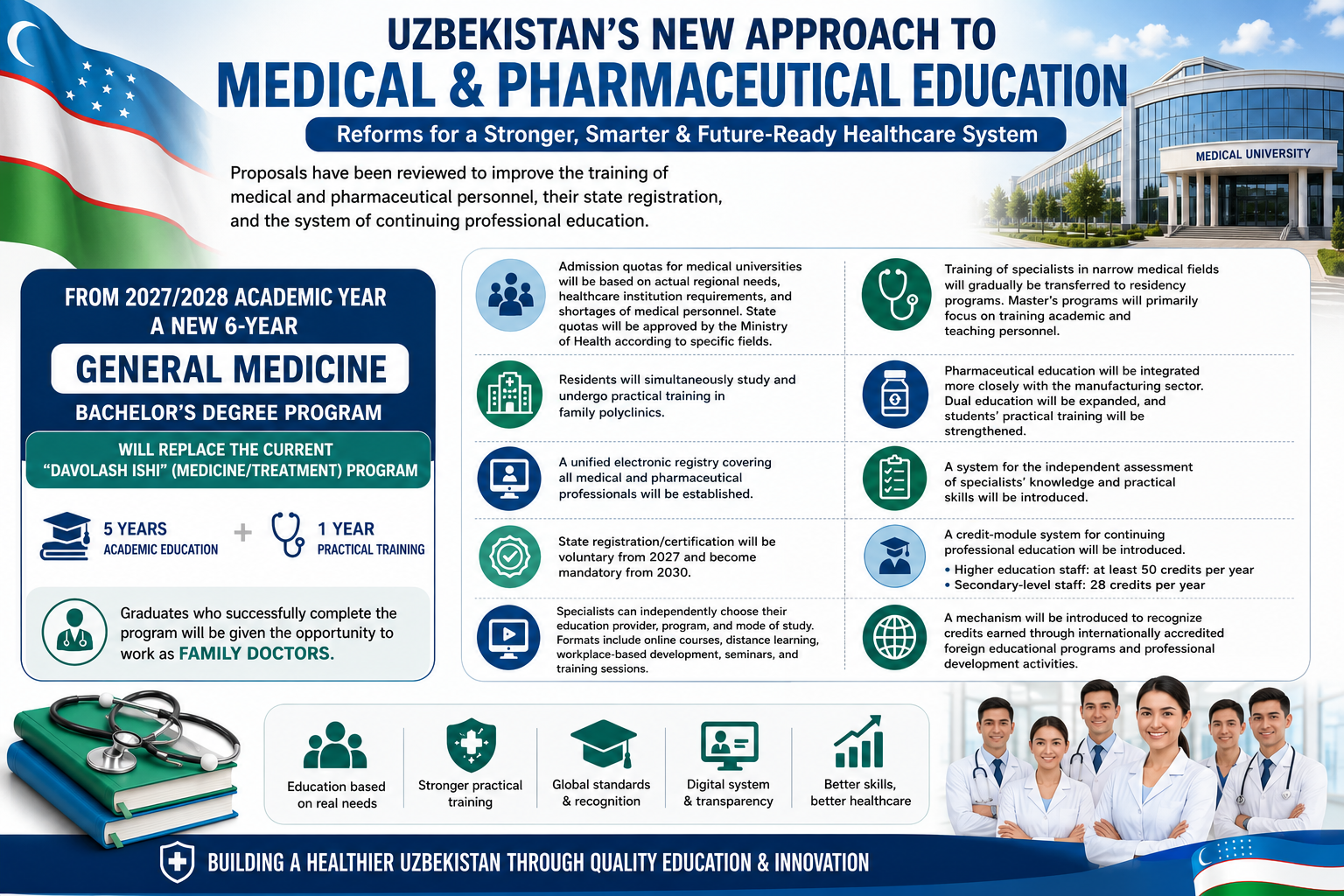
Uzbekistan is preparing for a major transformation of its medical education and healthcare workforce system. The proposed reforms aim to improve the quality of medical and pharmaceutical education, strengthen practical training, introduce independent assessment of medical professionals, and ensure continuous professional development throughout a healthcare worker’s career.
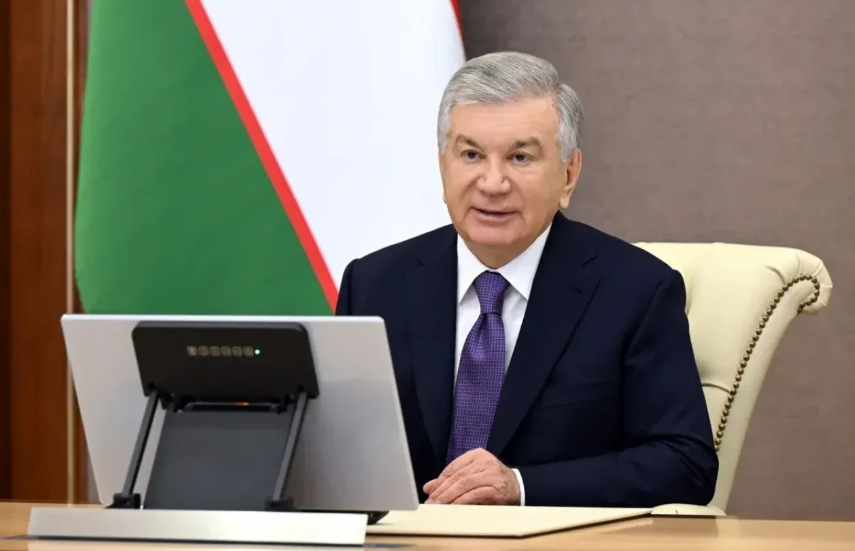
President Shavkat Mirziyoyev reviewed a presentation outlining proposals to modernize the system of medical and pharmaceutical personnel training, state registration, and continuing professional education.
These changes are part of Uzbekistan’s broader efforts to improve healthcare services, strengthen primary healthcare, and provide people with better access to modern diagnosis and treatment.
Moving Medical Education from Theory to Practical Skills
One of the biggest changes proposed is a shift in medical education.
Instead of focusing mainly on theoretical knowledge, medical universities will increasingly focus on competencies, clinical skills, practical training, and real-world healthcare needs.
The proposed reforms were developed with recommendations from leading international universities, including the University of Cambridge, the University of Pennsylvania, and Harvard University, along with international and local experts.
The goal is to bring Uzbekistan’s medical education system closer to modern international standards.
Medical Education Based on Healthcare Needs
In the future, admission quotas for medical universities will be linked more closely to the actual demand for healthcare professionals.
The number of students admitted will take into account:
- Healthcare workforce shortages
- Regional medical needs
- Requirements of hospitals and healthcare institutions
- Specific medical specialties in demand
- Long-term workforce planning
The Ministry of Health will approve state admission quotas according to different fields of study.
This approach is designed to reduce shortages of doctors and other healthcare professionals in areas where they are most needed.
New Six-Year General Medicine Program from 2027–2028
One of the most important proposals concerns undergraduate medical education.
Starting from the 2027/2028 academic year, Uzbekistan plans to introduce a six-year Bachelor’s degree program in General Medicine to replace the existing Medical Treatment program.
The proposed structure will include:
5 years of academic education + 1 full year of practical training
This means students will receive extensive theoretical and clinical education before completing a dedicated year of practical training.
Graduates who successfully complete the program will be eligible to work as family physicians.
This change is expected to place greater emphasis on practical competence and prepare graduates for the real needs of primary healthcare.
Greater Focus on Family Medicine
Family medicine will become an important part of the reformed medical education system.
Medical residents will combine classroom-based learning with practical experience at family polyclinics.
This model will allow future doctors to gain experience in:
- Patient examination
- Diagnosis
- Disease prevention
- Primary healthcare
- Treatment planning
- Long-term patient care
- Communication with patients and families
The training of specialized medical professionals will gradually move toward the residency system.
At the same time, master’s programs will increasingly focus on preparing researchers and teaching professionals.
Strengthening the Role of Nurses
The reforms will also introduce new approaches to the education of mid-level healthcare professionals.
Particular attention will be given to nurses with higher education.
Their role will be expanded so that they can work more closely with physicians in areas such as:
- Diagnosis
- Treatment support
- Disease prevention
- Patient care
- Clinical procedures
This could strengthen the overall healthcare team and allow doctors and nurses to work more efficiently.
Pharmaceutical Education to Become More Practical
Uzbekistan also plans to modernize pharmaceutical education.
Universities and pharmaceutical companies will work more closely together through dual education programs.
Students will receive greater exposure to real production environments and practical pharmaceutical processes.
Training will cover areas such as:
- Drug development
- Pharmaceutical production
- Quality control
- Standardization
- Manufacturing processes
- Pharmaceutical technologies
The objective is to prepare graduates with skills that directly match the needs of the pharmaceutical industry.
New State Registration System for Medical Professionals
Another major reform involves the introduction of a new state registration system for medical and pharmaceutical workers.
The system is designed to improve the quality and safety of healthcare services by independently assessing the knowledge and professional qualifications of specialists.
Unified Electronic Register
Uzbekistan plans to establish a unified electronic register covering medical and pharmaceutical professionals.
The system will be connected with 16 information databases.
It will bring together important information about healthcare professionals, including:
- Educational qualifications
- Professional qualifications
- Training
- Professional activities
- Other relevant career information
Having this information in one integrated system is expected to make professional qualification management more transparent and efficient.
State Registration from 2027 and Mandatory Registration from 2030
The proposed system is expected to be introduced gradually.
From 2027: State registration will initially be voluntary.
From 2030: State registration is proposed to become mandatory.
From 2030 onward, specialists who have not completed state registration would not be permitted to practice medical or pharmaceutical professions.
This represents a significant change in how professional qualifications will be monitored in Uzbekistan.
Independent Assessment of Medical Knowledge
Under the new system, medical and pharmaceutical professionals will undergo independent assessment.
The assessment will be conducted in stages.
First, specialists will be assessed in fundamental and clinical disciplines. They will then undergo assessment in their relevant specialty.
A unified bank of:
- Test questions
- Practical assignments
- Clinical scenarios
- Assessment materials
will be developed.
Modern simulation facilities will also be introduced to evaluate practical skills.
Importantly, specialists who do not pass an examination will have an opportunity to retake the assessment.
Incentives for Early Registration
Uzbekistan also plans to encourage medical and pharmaceutical workers to voluntarily participate in the new system before registration becomes mandatory.
Under the proposals, specialists with higher education who successfully pass the assessment and enter the state register could receive bonuses of up to five times the minimum wage.
Mid-level medical and pharmaceutical personnel could receive bonuses of up to 2.5 times the minimum wage.
These incentives are intended to encourage professionals to participate in the new system at an early stage.
New Center for Professional Qualification Assessment
A separate center will be established to organize state registration and assess the qualifications of medical and pharmaceutical professionals.
The center will play an important role in ensuring that professional assessments are organized according to consistent and modern standards.
Continuing Professional Education for Healthcare Workers
Medical knowledge is constantly changing.
New medicines, technologies, diagnostic methods and treatment approaches are introduced every year. Because of this, doctors, nurses, pharmacists and other healthcare professionals need to continuously update their knowledge and skills.
Uzbekistan therefore plans to introduce a new system of continuing professional education covering medical and pharmaceutical workers.
Credit-Based Professional Development
The new system will operate on a credit-module basis.
Healthcare professionals with higher education will be required to earn at least:
50 credits every year
Mid-level medical and pharmaceutical personnel will be required to earn:
28 credits every year
These credits will become important for state registration and confirmation of professional qualifications.
Flexible Learning Options
Healthcare professionals will have more freedom to choose how they continue their education.
They will be able to select:
- Education providers
- Training programs
- Study formats
- Professional development courses
Learning will not be limited to traditional classroom education.
Professionals will be able to earn credits through:
- Online courses
- Distance learning
- Workplace training
- Seminars
- Workshops
- Professional development programs
This flexible system could make continuing education more accessible to healthcare workers across Uzbekistan.
Recognition of International Training
Another important proposal is the recognition of professional development credits earned through internationally accredited foreign programs and events.
This could provide Uzbek healthcare professionals with greater opportunities to participate in international training, conferences, educational programs and professional development activities.
New Center for Continuing Professional Development
A dedicated Center for Continuing Professional Development is also proposed.
The center would be responsible for:
- Ensuring the quality of professional education
- Accrediting education providers
- Accrediting educational programs
- Introducing modern educational standards
- Supporting continuing professional development
This could create a more organized and transparent system for lifelong medical education.
Focus on Major Diseases and High-Risk Conditions
Professional education programs will focus strongly on diseases that are common among the population and those associated with a high risk of death.
Modern educational programs will be developed in important areas such as:
Cardiology
Training will focus on improving the ability of healthcare professionals to prevent, diagnose and manage cardiovascular diseases.
Emergency Medical Care
Healthcare workers will receive updated training in emergency diagnosis, rapid intervention and patient stabilization.
Oncology
Modern education in cancer diagnosis and treatment will be developed with leading international partners.
The involvement of international partners is expected to help bring modern clinical knowledge and practices into Uzbekistan’s healthcare education system.
One Integrated System for Medical Professionals
A key objective of the reforms is to connect different stages of a healthcare professional’s career into one system.
The proposed model can be understood as:
Medical Education → Practical Training → Independent Assessment → State Registration → Continuing Professional Education → Professional Qualification Renewal
This integrated approach is intended to ensure that healthcare professionals do not stop learning after graduation.
Instead, professional development will continue throughout their careers.
What These Reforms Could Mean for Medical Students
For students planning to study medicine in Uzbekistan, these proposed reforms are particularly important.
Future medical students may experience a system with greater emphasis on:
- Practical clinical training
- Competency-based education
- Family medicine
- Residency training
- Simulation-based learning
- Independent assessment
- Professional registration
- Continuing education
- International standards
The proposed six-year General Medicine program from the 2027/2028 academic year is especially significant for students entering medical education in the coming years.
Students and parents should therefore carefully check the latest admission rules, curriculum structure, university status and regulatory requirements before selecting a medical university.
What These Changes Mean for Uzbekistan’s Healthcare System
The reforms represent a broader effort to connect education with healthcare needs.
Rather than simply producing graduates, the new approach aims to prepare healthcare professionals who have the practical knowledge and skills required to serve patients effectively.
The system also places greater importance on:
Quality over quantity
Practical skills over theory alone
Continuous learning over one-time education
Independent assessment over qualification based only on university graduation
Patient safety and quality of care
These principles could play an important role in strengthening Uzbekistan’s healthcare workforce.
What This Means for the Future.
Uzbekistan is moving toward a new model of medical and pharmaceutical education that places greater emphasis on practical skills, professional competence, independent assessment and lifelong learning.
The proposed introduction of a six-year General Medicine bachelor’s program from the 2027/2028 academic year, stronger family medicine training, expanded nursing roles, practical pharmaceutical education, a unified electronic professional register and compulsory state registration from 2030 are among the major changes under consideration.
The new continuing professional education system will also require healthcare professionals to regularly update their knowledge and earn professional development credits.
President Shavkat Mirziyoyev has emphasized that these reforms should ultimately serve one central purpose: improving the quality of medical services and protecting patient safety.
For students considering medical education in Uzbekistan, the coming years could therefore bring significant changes to how doctors, nurses and pharmaceutical professionals are educated, assessed and developed throughout their careers.